var wc_single_product_params = {"i18n_required_rating_text":"Please select a rating","i18n_rating_options":["1 of 5 stars","2 of 5 stars","3 of 5 stars","4 of 5 stars","5 of 5 stars"],"i18n_product_gallery_trigger_text":"View full-screen image gallery","review_rating_required":"yes","flexslider":{"rtl":false,"animation":"slide","smoothHeight":true,"directionNav":true,"controlNav":"thumbnails","slideshow":false,"animationSpeed":500,"animationLoop":false,"allowOneSlide":false},"zoom_enabled":"1","zoom_options":[],"photoswipe_enabled":"1","photoswipe_options":{"shareEl":false,"closeOnScroll":false,"history":false,"hideAnimationDuration":0,"showAnimationDuration":0},"flexslider_enabled":"1"};
//# sourceURL=wc-single-product-js-extra
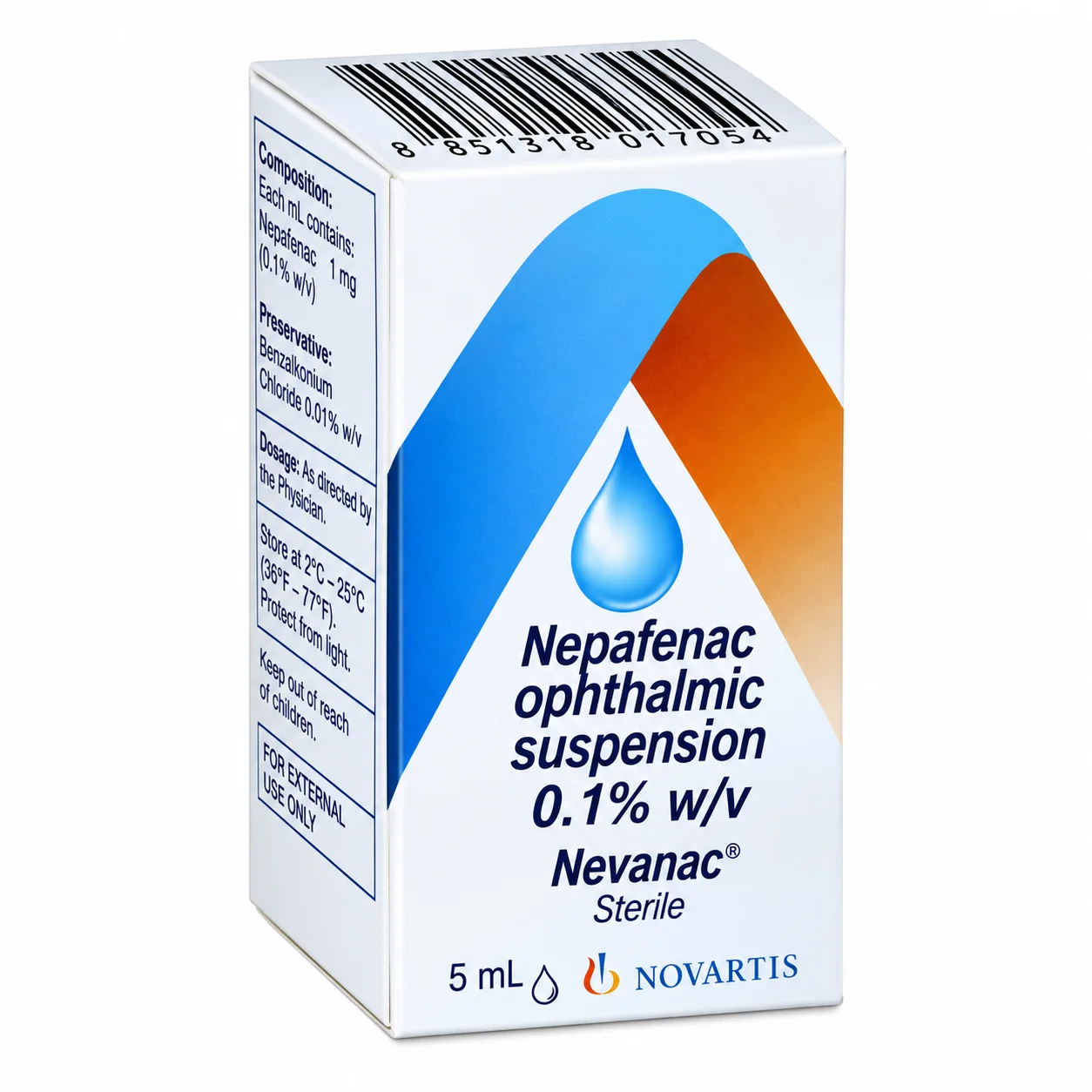
Nevanac Eye Drop is a prescription ophthalmic medication containing Nepafenac 0.1%, a non-steroidal anti-inflammatory drug (NSAID) formulated for administration into the eyes.
Nevanac Eye Drop is primarily used to manage eye pain and inflammation associated with cataract surgery. It works by reducing the production of certain chemical substances responsible for inflammation and pain within the eye.
Cataract surgery involves removing the cloudy natural lens of the eye and replacing it with an artificial intraocular lens. Following surgery, patients may experience inflammation, discomfort, redness, and sensitivity to light.
Nepafenac helps control postoperative inflammation by inhibiting the activity of cyclooxygenase enzymes after conversion into its active metabolite, Amfenac.
Nevanac ophthalmic suspension may be included in a comprehensive postoperative eye care treatment plan prescribed by an ophthalmologist.
It is not an antibiotic, corticosteroid, or general-purpose eye lubricant and should only be used under appropriate medical supervision.
How Does Nevanac Eye Drop Work?
Nevanac Eye Drop contains Nepafenac, an ophthalmic NSAID that acts as a prodrug.
After administration, Nepafenac penetrates the cornea and is converted by enzymes within ocular tissues into its active metabolite, Amfenac.
1. Inhibits Cyclooxygenase Enzymes
Amfenac inhibits cyclooxygenase enzymes involved in the production of prostaglandins.
Prostaglandins are chemical mediators associated with inflammation and pain.
2. Reduces Prostaglandin Production
By decreasing prostaglandin synthesis, Nepafenac helps control inflammatory responses associated with cataract surgery.
3. Helps Manage Postoperative Eye Pain
Nevanac Eye Drop helps reduce ocular pain associated with surgical inflammation when used as prescribed.
4. Controls Eye Inflammation
Nepafenac helps manage inflammatory processes within the eye following cataract surgery.
5. Supports Postoperative Eye Care
By controlling pain and inflammation, Nevanac may contribute to postoperative comfort as part of a specialist-directed treatment plan.
However, ophthalmic NSAIDs can also delay corneal healing in some patients, making appropriate monitoring important.
Uses and Benefits of Nevanac Eye Drop
1. Management of Postoperative Eye Inflammation
Nevanac Eye Drop is primarily prescribed to control inflammation associated with cataract surgery.
Inflammatory symptoms following surgery may include:
Eye redness
Ocular discomfort
Sensitivity to light
Inflammatory changes within the eye
Pain associated with surgical procedures
Nepafenac helps reduce inflammatory activity by inhibiting prostaglandin production.
It may be prescribed before and after surgery according to the ophthalmologist’s instructions.
3. Reduction of Postoperative Macular Edema Risk
In certain countries, Nepafenac ophthalmic suspension is also authorized to reduce the risk of postoperative macular edema associated with cataract surgery in patients with diabetes.
Macular edema involves fluid accumulation in the central part of the retina, which may affect visual clarity.
This indication depends on local regulatory approval and the specific product formulation.
4. Supporting Postoperative Eye Care
Nevanac Eye Drop may be included in a postoperative treatment plan alongside other prescribed ophthalmic medications.
These may include:
Antibiotic eye drops
Corticosteroid eye drops
Lubricating eye drops
Other specialist-prescribed ophthalmic treatments
The combination and duration of treatment should be determined by an ophthalmologist.
5. Management of Inflammatory Responses
Nepafenac helps regulate inflammatory responses associated with cataract surgery without belonging to the corticosteroid class of medications.
It should not be used for unrelated eye inflammation, infections, or injuries unless specifically prescribed.
Prodrug converted into active Amfenac within ocular tissues
Inhibits cyclooxygenase enzyme activity
Reduces prostaglandin production
Helps manage postoperative eye pain
Helps control inflammation following cataract surgery
May reduce postoperative macular edema risk in selected patients where approved
Non-steroidal formulation
Available as an ophthalmic suspension
Designed for topical ocular administration
Prescription-only eye care medication
How to Use Nevanac Eye Drop
Nevanac Eye Drop should be used exactly as prescribed by an ophthalmologist.
Step-by-Step Administration Instructions
Wash your hands thoroughly with soap and water.
Shake the bottle well before each use.
Remove the bottle cap without touching the dropper tip.
Tilt your head backward slightly.
Gently pull down the lower eyelid to create a small pocket.
Hold the dropper above the affected eye.
Instill the prescribed number of drops into the lower eyelid pocket.
Close your eye gently without blinking excessively.
Apply gentle pressure to the inner corner of the eye for approximately one minute.
Wipe away excess liquid using a clean tissue.
Replace the bottle cap securely.
Wash your hands after administration.
Avoid touching the dropper tip to the eye, eyelids, fingers, or any other surface to prevent contamination.
If you are using more than one ophthalmic medication, allow at least five minutes between applications unless your ophthalmologist advises otherwise.
Recommended Dosage
The appropriate dosage and treatment duration of Nevanac Eye Drop depend on several factors, including:
Type of ophthalmic procedure
Severity of postoperative inflammation
Patient’s medical history
Presence of diabetes
Corneal health
Other ophthalmic medications
Response to treatment
For the management of pain and inflammation associated with cataract surgery, a commonly prescribed regimen for Nepafenac 0.1% ophthalmic suspension is one drop in the affected eye three times daily, beginning one day before surgery, continuing on the day of surgery, and generally for two weeks afterward.
Different treatment durations may apply to other locally approved indications.
Important: Nepafenac 0.1% and Nepafenac 0.3% formulations have different dosing schedules and should not be used interchangeably without medical advice.
Do not increase the frequency or extend the treatment duration without consulting your ophthalmologist.
Possible Side Effects of Nevanac Eye Drop
Like other ophthalmic medications, Nevanac Eye Drop may cause side effects. Not everyone experiences them.
Commonly Reported Side Effects
Temporary blurred vision
Mild eye irritation
Eye discomfort
Foreign body sensation in the eye
Dry eyes
Increased tearing
Eye redness
Eyelid crusting
Mild burning or stinging sensation
Headache
Some symptoms may also be associated with cataract surgery itself.
Persistent or worsening symptoms should be discussed with an ophthalmologist.
Serious Side Effects
Although less common, Nepafenac ophthalmic suspension may cause serious adverse reactions, including:
Delayed corneal healing
Corneal inflammation (keratitis)
Corneal epithelial breakdown
Corneal thinning
Corneal erosion
Corneal ulceration
Corneal perforation
Increased ocular bleeding
Severe allergic reactions
These complications may threaten vision and require immediate medical attention.
Seek urgent ophthalmic care if you experience:
Severe or increasing eye pain
Sudden deterioration in vision
Significant eye redness or swelling
Persistent sensitivity to light
Unusual eye discharge
Severe irritation following administration
Stop using the medication and seek immediate medical advice if signs of serious corneal damage or an allergic reaction occur.
Warnings and Precautions
Before using Nevanac Eye Drop, inform your ophthalmologist about existing medical conditions, allergies, and medications.
1. NSAID Allergy
Patients with known hypersensitivity to Nepafenac or other components of the formulation should not use Nevanac Eye Drop.
Individuals with previous allergic reactions to Aspirin or other NSAIDs should inform their healthcare professional before use.
2. Corneal Disorders
Patients with existing corneal abnormalities, ocular surface disease, or a history of corneal complications may have an increased risk of serious adverse reactions.
3. Delayed Wound Healing
Topical ophthalmic NSAIDs may delay healing following eye surgery.
Concurrent use with ophthalmic corticosteroids may further increase the risk of healing complications.
4. Diabetes
Patients with diabetes may have an increased risk of corneal complications and require careful ophthalmic monitoring.
5. Bleeding Disorders
Nepafenac may increase the risk of ocular bleeding associated with surgery.
Patients with bleeding disorders or those taking anticoagulant medications should inform their healthcare professional.
6. Contact Lenses
Nevanac Eye Drop should not be administered while wearing contact lenses.
Patients undergoing cataract surgery should avoid wearing contact lenses unless their ophthalmologist confirms that it is appropriate.
7. Pregnancy
Nepafenac should only be used during pregnancy following medical assessment. NSAID-related risks are particularly important during later stages of pregnancy.
8. Breastfeeding
Breastfeeding individuals should consult their healthcare professional before using Nepafenac ophthalmic suspension.
9. Driving and Operating Machinery
Nevanac Eye Drop may cause temporary blurred vision after administration.
Avoid driving or operating machinery until your vision becomes clear.
10. Long-Term Use
Prolonged or inappropriate use of ophthalmic NSAIDs may increase the risk of corneal complications.
Use Nevanac Eye Drop only for the duration recommended by your ophthalmologist.
Drug Interactions
Nevanac Eye Drop may interact with certain ophthalmic and systemic medications.
Important considerations include:
Ophthalmic Corticosteroids: Concurrent use may increase the risk of delayed wound healing.
Anticoagulants: May increase the risk of bleeding complications in susceptible patients.
Antiplatelet Medicines: Additional caution may be required because of potential bleeding risks.
Other Ophthalmic NSAIDs: Combined use should only occur under specialist supervision.
Other Eye Drops: Appropriate intervals should be maintained between different ophthalmic medications.
Always inform your ophthalmologist about prescription medicines, over-the-counter medications, supplements, and other eye care products you are using.
Who Should Avoid Nevanac Eye Drop?
Nevanac Eye Drop should not be used by individuals with known hypersensitivity to Nepafenac or any ingredient in the formulation.
Additional medical assessment is necessary for patients with:
Previous serious reactions to NSAIDs
Aspirin-associated allergic reactions
Existing corneal damage
Severe ocular surface disorders
Rheumatoid arthritis
Diabetes-related ocular complications
Bleeding disorders
Recent complicated or repeated eye surgeries
A history of delayed corneal healing
Nevanac Eye Drop should not be used to treat bacterial, fungal, or viral eye infections.
Storage Instructions
To maintain the quality and effectiveness of Nevanac Eye Drop:
Store according to the manufacturer’s labeled temperature requirements.
Keep the bottle tightly closed when not in use.
Protect from excessive heat and direct sunlight.
Avoid contaminating the dropper tip.
Keep out of reach of children and pets.
Do not use after the expiration date.
Follow the product-specific instructions for disposal after opening.
Do not share the eye drop bottle with other individuals.
Do not use the suspension if contamination is suspected.
Frequently Asked Questions (FAQs)
Q1. What is Nevanac Eye Drop used for?
Nevanac Eye Drop is a prescription ophthalmic NSAID primarily used to manage pain and inflammation associated with cataract surgery.
Q2. What is the active ingredient in Nevanac Eye Drop?
The active ingredient is Nepafenac, commonly available in Nevanac as a 0.1% ophthalmic suspension.
Q3. Is Nevanac Eye Drop an antibiotic?
No. Nevanac contains Nepafenac, a non-steroidal anti-inflammatory drug. It does not treat bacterial eye infections.
Q4. Is Nevanac Eye Drop a steroid?
No. Nevanac is an NSAID ophthalmic medication and does not belong to the corticosteroid class.
Q5. How does Nevanac Eye Drop work?
Nepafenac penetrates ocular tissues and is converted into Amfenac, which inhibits cyclooxygenase enzymes and reduces prostaglandin production associated with inflammation and pain.
Q6. Can Nevanac Eye Drop be used after cataract surgery?
Yes. Nevanac is specifically used to manage pain and inflammation associated with cataract surgery under ophthalmic supervision.
Product Details
Description
Product Name
Nevanac Eye Drop
Generic Name
Nepafenac
Active Ingredient
Nepafenac
Strength
0.1% w/v (1 mg/ml)
Pack Size
Typically 5 ml; verify product packaging
Manufacturer / Brand
Alcon / Nevanac (market-dependent)
Dosage Form
Ophthalmic Suspension
Drug Category
Eye Care Medicine
Drug Class
Non-Steroidal Anti-Inflammatory Drug (NSAID)
Primary Use
Management of pain and inflammation associated with cataract surgery
Route of Administration
Ophthalmic (Eye)
Prescription Required
Yes
Storage Conditions
Store according to the manufacturer's packaging instructions
Pack sizes
1 eye drop, 3 eye drops, 6 eye drops
Reviews
There are no reviews yet.
Be the first to review “Nevanac Eye Drop (Nepafenac)” Cancel reply
var kirkiViewports = {"md":{"value":1200,"scale":1,"minWidth":1200,"maxWidth":1200,"title":"Desktop","icon":"desktop","activeIcon":"desktop-hover","id":"md","type":"max"},"tablet":{"value":1199,"scale":1,"minWidth":1199,"maxWidth":1199,"title":"Tablet","icon":"tablet-default","activeIcon":"tablet-hover","type":"max","id":"tablet"},"mobile":{"value":767,"scale":1,"minWidth":767,"maxWidth":767,"title":"Phone","icon":"phone-vr-default","activeIcon":"phone-vr-hover","type":"max","id":"mobile"}};
var kirkiCSSVariable = {"data":[{"title":"Colors","key":"color","modes":[{"title":"Default","key":"default"}],"variables":[]},{"title":"Numbers","key":"size","modes":[{"title":"Default","key":"default"}],"variables":[]},{"title":"Text Styles","key":"text-style","modes":[{"title":"Default","key":"default"}],"variables":[]},{"title":"Font Family","key":"font-family","modes":[{"title":"Default","key":"default"}],"variables":[]}]};
var elementorFrontendConfig = {"environmentMode":{"edit":false,"wpPreview":false,"isScriptDebug":false},"i18n":{"shareOnFacebook":"Share on Facebook","shareOnX":"Share on X","pinIt":"Pin it","download":"Download","downloadImage":"Download image","fullscreen":"Fullscreen","zoom":"Zoom","share":"Share","playVideo":"Play Video","previous":"Previous","next":"Next","close":"Close","a11yCarouselPrevSlideMessage":"Previous slide","a11yCarouselNextSlideMessage":"Next slide","a11yCarouselFirstSlideMessage":"This is the first slide","a11yCarouselLastSlideMessage":"This is the last slide","a11yCarouselPaginationBulletMessage":"Go to slide"},"is_rtl":false,"breakpoints":{"xs":0,"sm":480,"md":768,"lg":1025,"xl":1440,"xxl":1600},"responsive":{"breakpoints":{"mobile":{"label":"Mobile Portrait","value":767,"default_value":767,"direction":"max","is_enabled":true},"mobile_extra":{"label":"Mobile Landscape","value":880,"default_value":880,"direction":"max","is_enabled":false},"tablet":{"label":"Tablet Portrait","value":1024,"default_value":1024,"direction":"max","is_enabled":true},"tablet_extra":{"label":"Tablet Landscape","value":1200,"default_value":1200,"direction":"max","is_enabled":false},"laptop":{"label":"Laptop","value":1366,"default_value":1366,"direction":"max","is_enabled":false},"widescreen":{"label":"Widescreen","value":2400,"default_value":2400,"direction":"min","is_enabled":false}},"hasCustomBreakpoints":false},"version":"4.4.0","is_static":false,"experimentalFeatures":{"e_font_icon_svg":true,"additional_custom_breakpoints":true,"container":true,"theme_builder_v2":true,"e_mcp_revision_snapshots":true,"nested-elements":true,"import-export-customization":true,"e_pro_atomic_form":true,"e_pro_collection_loop":true,"mega-menu":true,"e_pro_variables":true,"e_pro_interactions":true},"urls":{"assets":"https:\/\/easyrxdrug.com\/wp-content\/plugins\/elementor\/assets\/","ajaxurl":"https:\/\/easyrxdrug.com\/wp-admin\/admin-ajax.php","uploadUrl":"https:\/\/easyrxdrug.com\/wp-content\/uploads"},"nonces":{"floatingButtonsClickTracking":"ff0cbda0f2","atomicFormsSendForm":"e0f24ef894"},"swiperClass":"swiper","settings":{"page":[],"editorPreferences":[]},"kit":{"active_breakpoints":["viewport_mobile","viewport_tablet"],"global_image_lightbox":"yes","lightbox_enable_counter":"yes","lightbox_enable_fullscreen":"yes","lightbox_enable_zoom":"yes","lightbox_enable_share":"yes","lightbox_title_src":"title","lightbox_description_src":"description","woocommerce_notices_elements":[]},"post":{"id":20859,"title":"Nevanac%20Eye%20Drop%20%28Nepafenac%29%20-%20EasyRxDrug","excerpt":"","featuredImage":"https:\/\/easyrxdrug.com\/wp-content\/uploads\/2026\/11\/770508e7-8257-49e7-b01d-9dccf39ebbae-1-1024x1024.webp"}};
//# sourceURL=elementor-frontend-js-before
var erxCart = {"refreshUrl":"/?wc-ajax=get_refreshed_fragments","qtyUrl":"/?wc-ajax=erx_cart_qty","i18n":{"item":"item","items":"items","error":"Could not update your cart. Please try again."}};
//# sourceURL=erx-cart-js-extra
var erxPP = {"ajaxUrl":"/?wc-ajax=add_to_cart","cartUrl":"https://easyrxdrug.com/cart/","checkoutUrl":"https://easyrxdrug.com/checkout/","currency":{"symbol":"$","decimals":2,"pos":"left"},"i18n":{"add":"Add to cart","added":"\u2713 Added to cart","error":"Could not add to cart. Please try again.","close":"Close","choose":"Choose pack size"}};
//# sourceURL=erx-product-js-extra
var gglcptch = {"options":{"version":"v2","sitekey":"6LdChI0oAAAAAE5UwhXqAHlTe_8Mi-6wUovqU909","error":"\u003Cstrong\u003EWarning\u003C/strong\u003E: More than one reCAPTCHA has been found in the current form. Please remove all unnecessary reCAPTCHA fields to make it work properly.","disable":0,"theme":"light"},"vars":{"visibility":false}};
//# sourceURL=gglcptch_script-js-extra
var wpforms_settings = {"val_required":"This field is required.","val_email":"Please enter a valid email address.","val_email_suggestion":"Did you mean {suggestion}?","val_email_suggestion_title":"Click to accept this suggestion.","val_email_restricted":"This email address is not allowed.","val_number":"Please enter a valid number.","val_number_positive":"Please enter a valid positive number.","val_minimum_price":"Amount entered is less than the required minimum.","val_confirm":"Field values do not match.","val_checklimit":"You have exceeded the number of allowed selections: {#}.","val_limit_characters":"{count} of {limit} max characters.","val_limit_words":"{count} of {limit} max words.","val_limit_min_characters":"Minimum is {min} characters. Characters needed: {needed}.","val_limit_min_words":"Minimum is {min} words. Words needed: {needed}.","val_limit_between_characters_needed":"Between {min} and {max} characters. Characters needed: {needed}","val_limit_between_characters_remaining":"Between {min} and {max} characters. Characters remaining: {remaining}","val_limit_between_words_needed":"Between {min} and {max} words. Words needed: {needed}","val_limit_between_words_remaining":"Between {min} and {max} words. Words remaining: {remaining}","val_min":"Please enter a value greater than or equal to {0}.","val_max":"Please enter a value less than or equal to {0}.","val_recaptcha_fail_msg":"Google reCAPTCHA verification failed, please try again later.","val_turnstile_fail_msg":"Cloudflare Turnstile verification failed, please try again later.","val_inputmask_incomplete":"Please fill out the field in required format.","uuid_cookie":"","locale":"en","country":"","country_list_label":"Country list","wpforms_plugin_url":"https:\/\/easyrxdrug.com\/wp-content\/plugins\/wpforms-lite\/","gdpr":"","ajaxurl":"https:\/\/easyrxdrug.com\/wp-admin\/admin-ajax.php","mailcheck_enabled":"1","mailcheck_domains":[],"mailcheck_toplevel_domains":["dev"],"is_ssl":"1","nonce":"219e985f82","currency_code":"USD","currency_thousands":",","currency_decimals":"2","currency_decimal":".","currency_symbol":"$","currency_symbol_pos":"left","val_requiredpayment":"Payment is required.","val_creditcard":"Please enter a valid credit card number.","css_vars":["field-border-radius","field-border-style","field-border-size","field-background-color","field-border-color","field-text-color","field-menu-color","label-color","label-sublabel-color","label-error-color","button-border-radius","button-border-style","button-border-size","button-background-color","button-border-color","button-text-color","page-break-color","background-image","background-position","background-repeat","background-size","background-width","background-height","background-color","background-url","container-padding","container-border-style","container-border-width","container-border-color","container-border-radius","field-size-input-height","field-size-input-spacing","field-size-font-size","field-size-line-height","field-size-padding-h","field-size-checkbox-size","field-size-sublabel-spacing","field-size-icon-size","label-size-font-size","label-size-line-height","label-size-sublabel-font-size","label-size-sublabel-line-height","button-size-font-size","button-size-height","button-size-padding-h","button-size-margin-top","container-shadow-size-box-shadow"],"isModernMarkupEnabled":"1","formErrorMessagePrefix":"Form error message","submitBtnDisabled":"Submit button is disabled during form submission.","readOnlyDisallowedFields":["captcha","map","content","divider","hidden","html","entry-preview","pagebreak","payment-total"],"error_updating_token":"Error updating token. Please try again or contact support if the issue persists.","network_error":"Network error or server is unreachable. Check your connection or try again later.","token_cache_lifetime":"86400","hn_data":{"20165":8},"analytics_composite_field_types":["name","address","date-time","email","password","paypal-commerce"],"analytics_base64":"1","address_field":{"list_countries_without_states":["GB","DE","CH","NL"]}}


 $9.00 – $29.00Price range: $9.00 through $29.00 Choose Pack This product has multiple variants. The options may be chosen on the product page


Reviews
There are no reviews yet.