var wc_single_product_params = {"i18n_required_rating_text":"Please select a rating","i18n_rating_options":["1 of 5 stars","2 of 5 stars","3 of 5 stars","4 of 5 stars","5 of 5 stars"],"i18n_product_gallery_trigger_text":"View full-screen image gallery","review_rating_required":"yes","flexslider":{"rtl":false,"animation":"slide","smoothHeight":true,"directionNav":true,"controlNav":"thumbnails","slideshow":false,"animationSpeed":500,"animationLoop":false,"allowOneSlide":false},"zoom_enabled":"1","zoom_options":[],"photoswipe_enabled":"1","photoswipe_options":{"shareEl":false,"closeOnScroll":false,"history":false,"hideAnimationDuration":0,"showAnimationDuration":0},"flexslider_enabled":"1"};
//# sourceURL=wc-single-product-js-extra
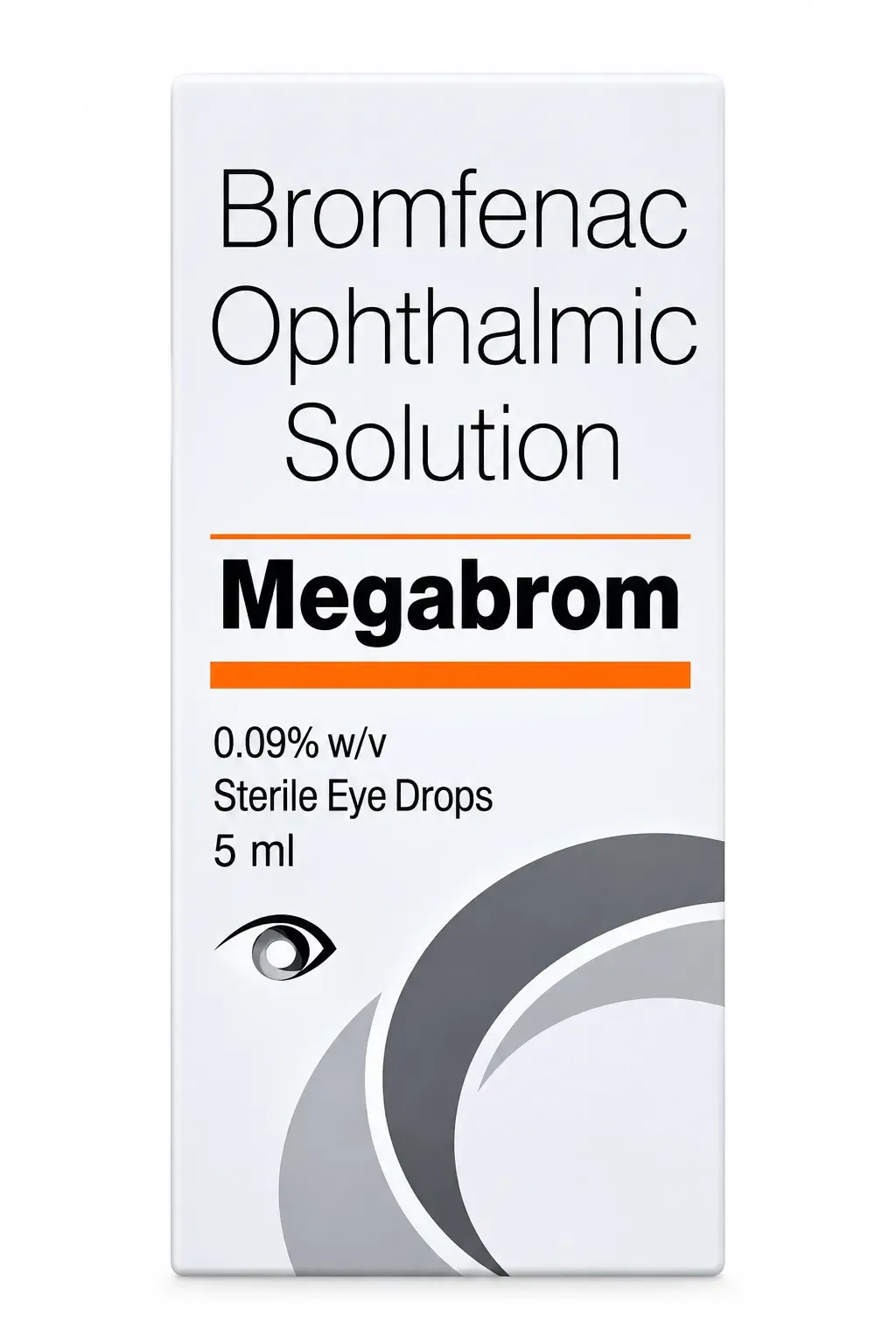
Megabrom Eye Drop is a prescription ophthalmic medicine containing bromfenac, a non-steroidal anti-inflammatory drug used to manage inflammation and pain associated with certain eye procedures.
Bromfenac belongs to the NSAID class of medicines.
It works by inhibiting cyclooxygenase (COX) enzymes involved in the production of prostaglandins.
Prostaglandins are chemical mediators that contribute to inflammation, swelling, pain, and other inflammatory responses.
Following cataract surgery, the eye may develop temporary inflammation as part of the healing process.
This inflammation can cause redness, discomfort, sensitivity, and irritation.
Yes, an ophthalmologist may prescribe bromfenac alongside other postoperative medicines.
When multiple eye drops are used, separate administration according to the prescriber’s instructions. A gap of at least five minutes is commonly recommended.
What If a Dose Is Missed?
Use the missed dose when remembered unless it is nearly time for the next scheduled dose.
Do not use extra drops to compensate for a missed dose.
Can Megabrom Be Used Daily?
Yes, when prescribed for a specific treatment period.
Do not continue treatment longer than recommended.
Can Megabrom Be Used Before Cataract Surgery?
Some bromfenac formulations are started before cataract surgery, while others begin afterward.
Follow the instructions for the specific product and surgical treatment plan.
How Long Does Megabrom Eye Drop Take to Work?
Bromfenac begins inhibiting prostaglandin production after reaching the relevant eye tissues.
The time required for noticeable symptom improvement varies.
Postoperative inflammation and discomfort may improve over the prescribed treatment period.
The response depends on the type of surgery, severity of inflammation, product formulation, and individual healing process.
Follow-up examinations help determine whether inflammation is resolving appropriately.
Common Side Effects
Possible side effects include:
Temporary eye irritation
Burning sensation
Stinging after application
Eye discomfort
Redness
Itching
Watery eyes
Temporary blurred vision
Foreign-body sensation
Eye pain
Increased sensitivity to light
Not every patient experiences these effects.
Potentially Harmful Effects & Serious Health Risks
1. Corneal Epithelial Breakdown
Ophthalmic NSAIDs may cause damage to the surface cells of the cornea.
2. Corneal Thinning
Rarely, prolonged or inappropriate use may contribute to corneal thinning.
3. Corneal Ulceration
Serious corneal complications may develop in susceptible patients.
4. Corneal Perforation
Rare severe cases of corneal damage may lead to perforation and threaten vision.
5. Delayed Wound Healing
Ophthalmic NSAIDs may delay healing after eye surgery.
6. Increased Bleeding Tendency
Bromfenac may increase bleeding time and the risk of ocular tissue bleeding in susceptible patients.
7. Severe Hypersensitivity
Allergic reactions may occur, particularly in patients sensitive to NSAIDs.
8. Persistent Eye Pain
Worsening pain may indicate a postoperative complication.
9. Vision Changes
Persistent blurred vision or reduced visual acuity requires prompt assessment.
10. Increased Ocular Irritation
Some patients may experience worsening irritation or inflammation.
11. Corneal Complications in High-Risk Patients
Patients with diabetes, dry eye disease, rheumatoid arthritis, or existing corneal abnormalities may have an increased risk of adverse corneal effects.
12. Complications From Prolonged Use
Using ophthalmic NSAIDs beyond the recommended treatment period may increase the risk of corneal adverse events.
Emergency warning: Stop using the drops and seek urgent ophthalmic assessment if severe eye pain, reduced vision, marked light sensitivity, or signs of corneal damage occur.
Contraindications & Safety Precautions
1. Hypersensitivity to Bromfenac
Do not use if allergic to bromfenac or any formulation component.
2. NSAID Allergy
Patients with previous allergic reactions to aspirin or other NSAIDs require caution.
3. Asthma Associated With NSAID Sensitivity
Patients with aspirin-sensitive asthma or NSAID-triggered allergic reactions should inform their ophthalmologist.
4. Corneal Disease
Existing corneal disorders may increase the risk of serious complications.
5. Dry Eye Disease
Patients with significant dry eye disease may require additional monitoring.
6. Diabetes
Diabetes may increase the risk of delayed corneal healing.
7. Rheumatoid Arthritis
Patients with rheumatoid arthritis may have an increased risk of corneal complications.
8. Repeated Eye Surgery
Patients who have undergone multiple ophthalmic procedures may require closer monitoring.
9. Delayed Healing
Use cautiously in patients with conditions associated with impaired wound healing.
10. Bleeding Disorders
Inform the prescriber about any bleeding disorder.
11. Anticoagulant Medicines
Patients taking anticoagulants or antiplatelet medicines should inform their ophthalmologist.
12. Concurrent Corticosteroid Eye Drops
Combined use of ophthalmic NSAIDs and corticosteroids may increase the potential for delayed healing in certain patients.
13. Contact Lens Use
Avoid contact lenses during postoperative recovery unless the ophthalmologist specifically permits them.
14. Pregnancy
Use during pregnancy requires medical assessment. NSAID exposure later in pregnancy raises additional concerns.
15. Breastfeeding
A healthcare professional should assess the need for treatment and potential risks.
16. Children
Pediatric use depends on the approved labeling and clinical assessment.
17. Prolonged Treatment
Do not use beyond the recommended duration without specialist supervision.
18. Drug Interactions
Potentially relevant interactions include:
Other Ophthalmic NSAIDs: May increase local adverse effects.
Ophthalmic Corticosteroids: May increase the potential for delayed healing.
Anticoagulants: May increase bleeding concerns.
Antiplatelet Medicines: May increase bleeding concerns.
Other Eye Drops: Follow recommended spacing instructions.
19. Medical Monitoring
Healthcare professionals may monitor:
Postoperative inflammation
Eye pain
Redness
Corneal integrity
Wound healing
Visual acuity
Signs of corneal irritation
Signs of infection
Treatment response
Adverse reactions
Duration of therapy
Postoperative recovery
Advantages
Contains bromfenac
Ophthalmic NSAID formulation
Helps reduce postoperative inflammation
Helps manage eye pain after cataract surgery
Reduces prostaglandin production
Non-steroidal anti-inflammatory activity
Localized ophthalmic administration
May support postoperative comfort
Used in prescribed cataract surgery recovery plans
var kirkiViewports = {"md":{"value":1200,"scale":1,"minWidth":1200,"maxWidth":1200,"title":"Desktop","icon":"desktop","activeIcon":"desktop-hover","id":"md","type":"max"},"tablet":{"value":1199,"scale":1,"minWidth":1199,"maxWidth":1199,"title":"Tablet","icon":"tablet-default","activeIcon":"tablet-hover","type":"max","id":"tablet"},"mobile":{"value":767,"scale":1,"minWidth":767,"maxWidth":767,"title":"Phone","icon":"phone-vr-default","activeIcon":"phone-vr-hover","type":"max","id":"mobile"}};
var kirkiCSSVariable = {"data":[{"title":"Colors","key":"color","modes":[{"title":"Default","key":"default"}],"variables":[]},{"title":"Numbers","key":"size","modes":[{"title":"Default","key":"default"}],"variables":[]},{"title":"Text Styles","key":"text-style","modes":[{"title":"Default","key":"default"}],"variables":[]},{"title":"Font Family","key":"font-family","modes":[{"title":"Default","key":"default"}],"variables":[]}]};
var elementorFrontendConfig = {"environmentMode":{"edit":false,"wpPreview":false,"isScriptDebug":false},"i18n":{"shareOnFacebook":"Share on Facebook","shareOnX":"Share on X","pinIt":"Pin it","download":"Download","downloadImage":"Download image","fullscreen":"Fullscreen","zoom":"Zoom","share":"Share","playVideo":"Play Video","previous":"Previous","next":"Next","close":"Close","a11yCarouselPrevSlideMessage":"Previous slide","a11yCarouselNextSlideMessage":"Next slide","a11yCarouselFirstSlideMessage":"This is the first slide","a11yCarouselLastSlideMessage":"This is the last slide","a11yCarouselPaginationBulletMessage":"Go to slide"},"is_rtl":false,"breakpoints":{"xs":0,"sm":480,"md":768,"lg":1025,"xl":1440,"xxl":1600},"responsive":{"breakpoints":{"mobile":{"label":"Mobile Portrait","value":767,"default_value":767,"direction":"max","is_enabled":true},"mobile_extra":{"label":"Mobile Landscape","value":880,"default_value":880,"direction":"max","is_enabled":false},"tablet":{"label":"Tablet Portrait","value":1024,"default_value":1024,"direction":"max","is_enabled":true},"tablet_extra":{"label":"Tablet Landscape","value":1200,"default_value":1200,"direction":"max","is_enabled":false},"laptop":{"label":"Laptop","value":1366,"default_value":1366,"direction":"max","is_enabled":false},"widescreen":{"label":"Widescreen","value":2400,"default_value":2400,"direction":"min","is_enabled":false}},"hasCustomBreakpoints":false},"version":"4.4.0","is_static":false,"experimentalFeatures":{"e_font_icon_svg":true,"additional_custom_breakpoints":true,"container":true,"theme_builder_v2":true,"e_mcp_revision_snapshots":true,"nested-elements":true,"import-export-customization":true,"e_pro_atomic_form":true,"e_pro_collection_loop":true,"mega-menu":true,"e_pro_variables":true,"e_pro_interactions":true},"urls":{"assets":"https:\/\/easyrxdrug.com\/wp-content\/plugins\/elementor\/assets\/","ajaxurl":"https:\/\/easyrxdrug.com\/wp-admin\/admin-ajax.php","uploadUrl":"https:\/\/easyrxdrug.com\/wp-content\/uploads"},"nonces":{"floatingButtonsClickTracking":"ec621973a0","atomicFormsSendForm":"008008087d"},"swiperClass":"swiper","settings":{"page":[],"editorPreferences":[]},"kit":{"active_breakpoints":["viewport_mobile","viewport_tablet"],"global_image_lightbox":"yes","lightbox_enable_counter":"yes","lightbox_enable_fullscreen":"yes","lightbox_enable_zoom":"yes","lightbox_enable_share":"yes","lightbox_title_src":"title","lightbox_description_src":"description","woocommerce_notices_elements":[]},"post":{"id":20847,"title":"Megabrom%20Eye%20Drop%20%28Bromfenac%29%20-%20EasyRxDrug","excerpt":"","featuredImage":"https:\/\/easyrxdrug.com\/wp-content\/uploads\/2026\/11\/Bromfenac-Ophthalmic-Solution-Packaging-683x1024.webp"}};
//# sourceURL=elementor-frontend-js-before
var erxCart = {"refreshUrl":"/?wc-ajax=get_refreshed_fragments","qtyUrl":"/?wc-ajax=erx_cart_qty","i18n":{"item":"item","items":"items","error":"Could not update your cart. Please try again."}};
//# sourceURL=erx-cart-js-extra
var erxPP = {"ajaxUrl":"/?wc-ajax=add_to_cart","cartUrl":"https://easyrxdrug.com/cart/","checkoutUrl":"https://easyrxdrug.com/checkout/","currency":{"symbol":"$","decimals":2,"pos":"left"},"i18n":{"add":"Add to cart","added":"\u2713 Added to cart","error":"Could not add to cart. Please try again.","close":"Close","choose":"Choose pack size"}};
//# sourceURL=erx-product-js-extra
var glaGtagData = {"currency_minor_unit":"2","products":{"20761":{"name":"Cyclophil Me 100 Mg (Cyclosporine)","price":69},"20719":{"name":"Andre I Kul 10 ml","price":14},"20698":{"name":"Bepotastine Eye Drop USA","price":11},"20682":{"name":"Azithral Eye Ointment","price":19.1},"20847":{"name":"Megabrom Eye Drop (Bromfenac)","price":6}}};
//# sourceURL=gla-gtag-events-js-extra
var gglcptch = {"options":{"version":"v2","sitekey":"6LdChI0oAAAAAE5UwhXqAHlTe_8Mi-6wUovqU909","error":"\u003Cstrong\u003EWarning\u003C/strong\u003E: More than one reCAPTCHA has been found in the current form. Please remove all unnecessary reCAPTCHA fields to make it work properly.","disable":0,"theme":"light"},"vars":{"visibility":false}};
//# sourceURL=gglcptch_script-js-extra
var wpforms_settings = {"val_required":"This field is required.","val_email":"Please enter a valid email address.","val_email_suggestion":"Did you mean {suggestion}?","val_email_suggestion_title":"Click to accept this suggestion.","val_email_restricted":"This email address is not allowed.","val_number":"Please enter a valid number.","val_number_positive":"Please enter a valid positive number.","val_minimum_price":"Amount entered is less than the required minimum.","val_confirm":"Field values do not match.","val_checklimit":"You have exceeded the number of allowed selections: {#}.","val_limit_characters":"{count} of {limit} max characters.","val_limit_words":"{count} of {limit} max words.","val_limit_min_characters":"Minimum is {min} characters. Characters needed: {needed}.","val_limit_min_words":"Minimum is {min} words. Words needed: {needed}.","val_limit_between_characters_needed":"Between {min} and {max} characters. Characters needed: {needed}","val_limit_between_characters_remaining":"Between {min} and {max} characters. Characters remaining: {remaining}","val_limit_between_words_needed":"Between {min} and {max} words. Words needed: {needed}","val_limit_between_words_remaining":"Between {min} and {max} words. Words remaining: {remaining}","val_min":"Please enter a value greater than or equal to {0}.","val_max":"Please enter a value less than or equal to {0}.","val_recaptcha_fail_msg":"Google reCAPTCHA verification failed, please try again later.","val_turnstile_fail_msg":"Cloudflare Turnstile verification failed, please try again later.","val_inputmask_incomplete":"Please fill out the field in required format.","uuid_cookie":"","locale":"en","country":"","country_list_label":"Country list","wpforms_plugin_url":"https:\/\/easyrxdrug.com\/wp-content\/plugins\/wpforms-lite\/","gdpr":"","ajaxurl":"https:\/\/easyrxdrug.com\/wp-admin\/admin-ajax.php","mailcheck_enabled":"1","mailcheck_domains":[],"mailcheck_toplevel_domains":["dev"],"is_ssl":"1","nonce":"a4074b18be","currency_code":"USD","currency_thousands":",","currency_decimals":"2","currency_decimal":".","currency_symbol":"$","currency_symbol_pos":"left","val_requiredpayment":"Payment is required.","val_creditcard":"Please enter a valid credit card number.","css_vars":["field-border-radius","field-border-style","field-border-size","field-background-color","field-border-color","field-text-color","field-menu-color","label-color","label-sublabel-color","label-error-color","button-border-radius","button-border-style","button-border-size","button-background-color","button-border-color","button-text-color","page-break-color","background-image","background-position","background-repeat","background-size","background-width","background-height","background-color","background-url","container-padding","container-border-style","container-border-width","container-border-color","container-border-radius","field-size-input-height","field-size-input-spacing","field-size-font-size","field-size-line-height","field-size-padding-h","field-size-checkbox-size","field-size-sublabel-spacing","field-size-icon-size","label-size-font-size","label-size-line-height","label-size-sublabel-font-size","label-size-sublabel-line-height","button-size-font-size","button-size-height","button-size-padding-h","button-size-margin-top","container-shadow-size-box-shadow"],"isModernMarkupEnabled":"1","formErrorMessagePrefix":"Form error message","submitBtnDisabled":"Submit button is disabled during form submission.","readOnlyDisallowedFields":["captcha","map","content","divider","hidden","html","entry-preview","pagebreak","payment-total"],"error_updating_token":"Error updating token. Please try again or contact support if the issue persists.","network_error":"Network error or server is unreachable. Check your connection or try again later.","token_cache_lifetime":"86400","hn_data":{"20165":8},"analytics_composite_field_types":["name","address","date-time","email","password","paypal-commerce"],"analytics_base64":"1","address_field":{"list_countries_without_states":["GB","DE","CH","NL"]}}


 $69.00 – $200.00Price range: $69.00 through $200.00 Choose Pack This product has multiple variants. The options may be chosen on the product page


Reviews
There are no reviews yet.