
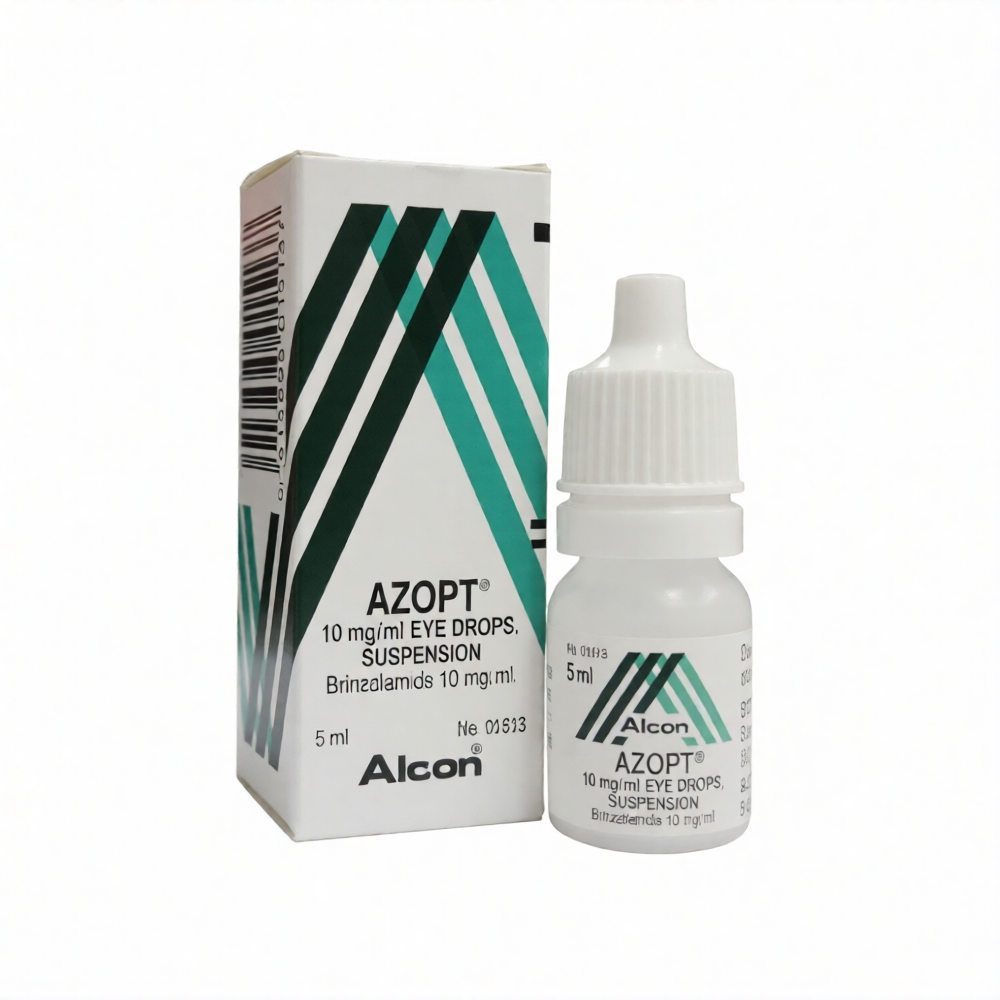
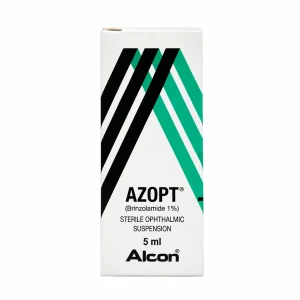
Azopt Eye Drop 1% (5 ml)
Want to order in bulk / B2B price?
Every order ships with a tracking number. Standard delivery takes 12–15 days.
If your parcel doesn't arrive, choose a new package or a full refund.
Call +1 251-332-4105 or email [email protected].
Share
What Is Azopt Eye Drops 1%?
Azopt Eye Drops 1% (5 ml) is a prescription ophthalmic medicine containing Brinzolamide 1%, used to reduce elevated intraocular pressure (IOP) in patients with open-angle glaucoma or ocular hypertension.
Glaucoma is a group of eye conditions that can damage the optic nerve, often associated with increased pressure inside the eye. If left untreated, glaucoma can lead to irreversible vision loss.
Azopt helps lower eye pressure and reduces the risk of pressure-related optic nerve damage. It may be prescribed alone or alongside other glaucoma medicines, depending on the patient’s condition.
How Does Azopt Eye Drops Work?
Azopt contains Brinzolamide, a carbonic anhydrase inhibitor that reduces the production of aqueous humor, the fluid naturally present inside the eye.
By inhibiting carbonic anhydrase II in the eye’s ciliary processes, Brinzolamide decreases fluid formation, helping lower intraocular pressure.
Reducing elevated eye pressure is an important part of managing glaucoma and ocular hypertension.
How to Use Azopt Eye Drops 1%
- Use Azopt only as prescribed by your ophthalmologist.
- Wash your hands thoroughly before application.
- Shake the bottle well before each use, as Azopt is an ophthalmic suspension.
- Tilt your head backward and gently pull down your lower eyelid.
- Instill the prescribed number of drops into the affected eye.
- Avoid touching the dropper tip to your eye, eyelids, or other surfaces.
- Close your eyes gently after application.
- If using other ophthalmic medicines, maintain an interval of at least 10 minutes between products unless your doctor advises otherwise.
- Follow the prescribed treatment schedule consistently.
The commonly labeled adult dosage is one drop in the affected eye or eyes three times daily. However, the exact schedule should follow your ophthalmologist’s prescription.
Common Side Effects
Possible side effects include:
- Temporary blurred vision
- Bitter or unusual taste in the mouth
- Eye discomfort
- Burning or stinging sensation
- Eye redness
- Dry eyes
- Foreign-body sensation
- Headache
- Mild eye irritation
These effects are generally temporary, but persistent symptoms should be discussed with an eye-care professional.
Serious Side Effects
Seek medical attention if you experience:
- Severe eye pain or persistent irritation
- Significant eye swelling
- Sudden or worsening vision changes
- Severe allergic reactions
- Skin rash or blistering
- Difficulty breathing
- Signs of serious systemic reactions
Brinzolamide is a sulfonamide-derived medicine. Although applied to the eye, some medication is absorbed into the bloodstream, and serious sulfonamide-related reactions are possible.
Contraindications & Precautions
Before using Azopt Eye Drops, inform your healthcare professional if you:
- Have an allergy to Brinzolamide or any ingredient in the formulation.
- Have a history of serious sulfonamide-related allergic reactions.
- Have severe kidney impairment.
- Have liver disease.
- Have certain corneal conditions.
- Are taking oral carbonic anhydrase inhibitors.
- Are pregnant, planning pregnancy, or breastfeeding.
- Use other prescription or nonprescription eye medicines.
Contact lenses: Azopt contains benzalkonium chloride in commonly marketed formulations. Remove soft contact lenses before application and wait at least 15 minutes before reinserting them, unless the specific product label advises otherwise.
Avoid driving or operating machinery until temporary blurred vision has resolved.
Advantages
- Helps reduce elevated intraocular pressure.
- Used in the management of open-angle glaucoma and ocular hypertension.
- Reduces aqueous humor production.
- Can be prescribed alongside certain other glaucoma medicines.
- Convenient 5 ml ophthalmic bottle.
- Provides localized treatment directly to the eye.
Disadvantages / Limitations
- May cause temporary blurred vision or eye irritation.
- Can produce a bitter taste after application.
- Requires consistent administration for effective pressure control.
- Does not restore vision already lost due to glaucoma.
- May not be suitable for patients with severe kidney impairment.
- Requires regular intraocular pressure monitoring.
- Does not permanently cure glaucoma.
Important Notes
Azopt Eye Drops 1% is a prescription medicine intended for controlling elevated eye pressure.
Patients with glaucoma may not experience noticeable symptoms during the early stages of the disease. Therefore, regular eye examinations and pressure monitoring are essential, even when vision appears normal.
Do not discontinue Azopt without consulting your ophthalmologist, as uncontrolled eye pressure can increase the risk of permanent optic nerve damage.
Store the bottle according to the manufacturer’s instructions and avoid contaminating the dropper tip.
Frequently Asked Questions
What is Azopt Eye Drops 1% used for?
Azopt is used to lower elevated intraocular pressure in patients with open-angle glaucoma or ocular hypertension.
What is the active ingredient in Azopt Eye Drops?
Azopt contains Brinzolamide 1% w/v, equivalent to 10 mg/ml.
How does Azopt help glaucoma patients?
Azopt reduces the production of fluid inside the eye, helping lower intraocular pressure and reduce the risk of further optic nerve damage.
How often should Azopt Eye Drops be used?
The commonly recommended dosage is one drop in the affected eye or eyes three times daily. Follow the schedule prescribed by your ophthalmologist.
Should I shake Azopt Eye Drops before use?
Yes. Azopt is an ophthalmic suspension and should be shaken well before each application.
Can Azopt Eye Drops cure glaucoma?
No. Azopt helps control elevated eye pressure but does not cure glaucoma or reverse existing optic nerve damage.
Can I use Azopt with other glaucoma eye drops?
Yes, your ophthalmologist may prescribe Azopt alongside other eye-pressure-lowering medicines. Follow the recommended interval between different eye drops.
Can Azopt cause blurred vision?
Yes. Temporary blurred vision can occur after application. Avoid driving until your vision becomes clear.
Is Azopt Eye Drops a steroid?
No. Azopt contains Brinzolamide, a carbonic anhydrase inhibitor. It is neither a steroid nor a hormone.
Can I stop using Azopt when my eyes feel normal?
No. Glaucoma and elevated eye pressure may not cause noticeable symptoms. Do not stop prescribed treatment without medical advice.
| Product Name | Azopt Eye Drops 1% |
|---|---|
| Brand Name | Azopt |
| Active Ingredient | Brinzolamide |
| Strength | 1% w/v (10 mg/ml) |
| Dosage Form | Ophthalmic Suspension |
| Pack Size | 5 ml |
| Route of Administration | Ophthalmic (Eye Use) |
| Manufacturer / Brand Owner | Alcon |
| Therapeutic Class | Carbonic Anhydrase Inhibitor |
| Category | Eye Care / Glaucoma Treatment |
| Prescription Status | Prescription medicine |
| Pack sizes | 1 eye drop, 3 eye drops, 6 eye drops |
Related products
-
 $11.00 – $48.00Price range: $11.00 through $48.00 Choose Pack This product has multiple variants. The options may be chosen on the product page
-
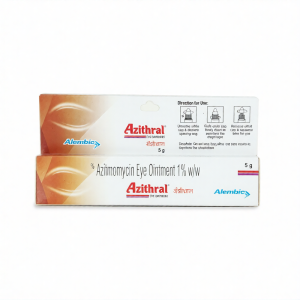
 $32.00 – $118.00Price range: $32.00 through $118.00 Choose Pack This product has multiple variants. The options may be chosen on the product page
-
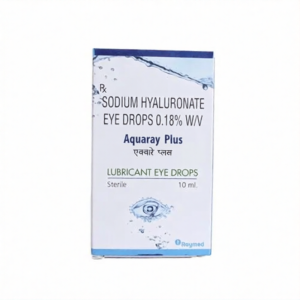
 $19.10 – $55.60Price range: $19.10 through $55.60 Choose Pack This product has multiple variants. The options may be chosen on the product page
-
 $41.40 – $122.22Price range: $41.40 through $122.22 Choose Pack This product has multiple variants. The options may be chosen on the product page
Reviews
There are no reviews yet.