var wc_single_product_params = {"i18n_required_rating_text":"Please select a rating","i18n_rating_options":["1 of 5 stars","2 of 5 stars","3 of 5 stars","4 of 5 stars","5 of 5 stars"],"i18n_product_gallery_trigger_text":"View full-screen image gallery","review_rating_required":"yes","flexslider":{"rtl":false,"animation":"slide","smoothHeight":true,"directionNav":true,"controlNav":"thumbnails","slideshow":false,"animationSpeed":500,"animationLoop":false,"allowOneSlide":false},"zoom_enabled":"1","zoom_options":[],"photoswipe_enabled":"1","photoswipe_options":{"shareEl":false,"closeOnScroll":false,"history":false,"hideAnimationDuration":0,"showAnimationDuration":0},"flexslider_enabled":"1"};
//# sourceURL=wc-single-product-js-extra
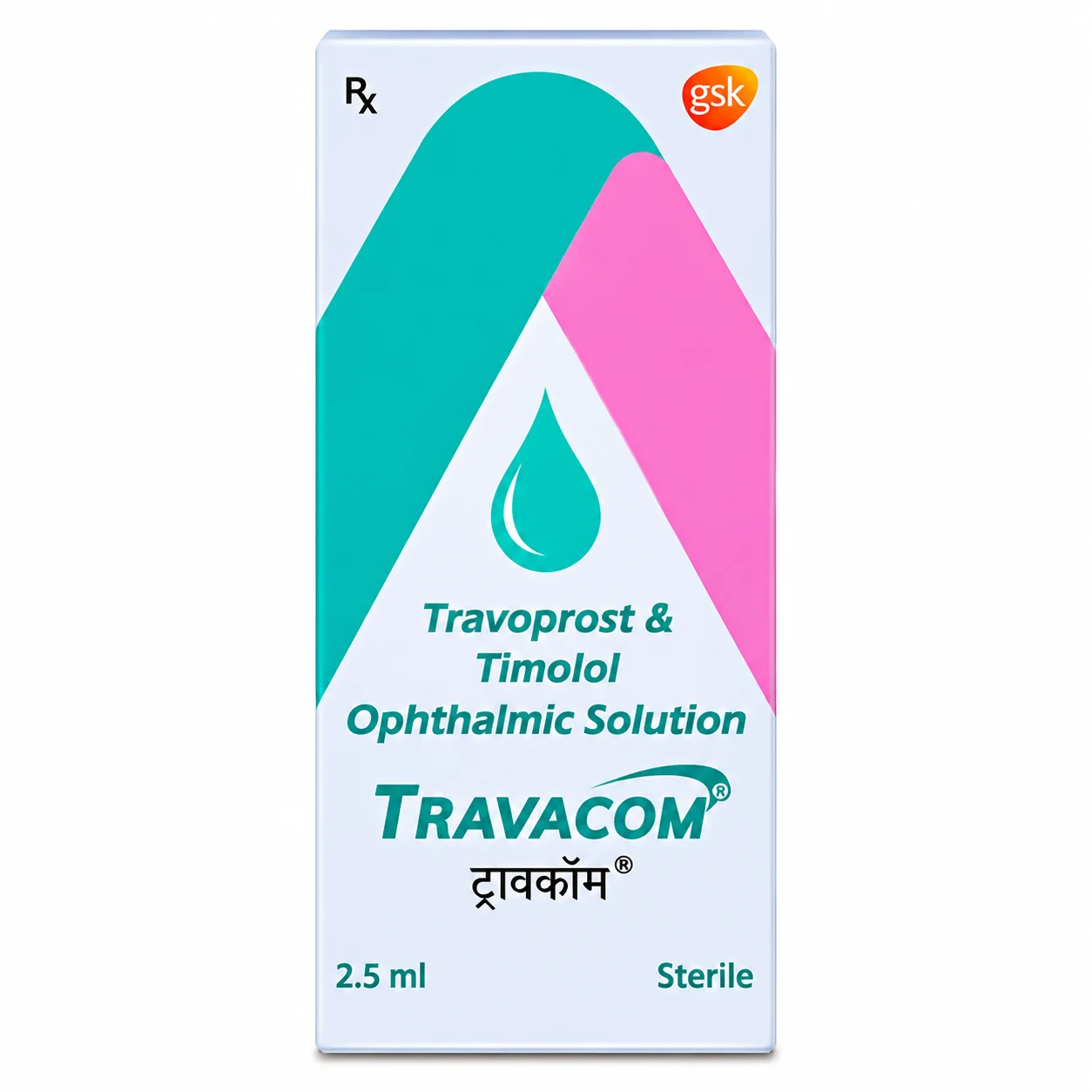
Travacom Eye Drop is a prescription ophthalmic medication containing Travoprost 0.004% and Timolol 0.5%, formulated to manage elevated intraocular pressure (IOP) in adults with open-angle glaucoma and ocular hypertension.
Glaucoma is a progressive eye condition that damages the optic nerve and may lead to permanent vision loss if not properly managed. Elevated intraocular pressure is an important risk factor associated with glaucoma progression.
Travacom combines two active ingredients that work through different mechanisms to control pressure inside the eye. Travoprost increases the drainage of aqueous humor, while Timolol reduces its production.
This dual-action formulation may be prescribed when treatment with a single pressure-lowering medication does not provide adequate intraocular pressure control.
Travacom does not cure glaucoma or restore vision already lost because of optic nerve damage. However, appropriate treatment can help reduce the risk of further glaucoma-related damage.
Composition of Travacom Eye Drops
Travoprost 0.004% w/v
Travoprost is a synthetic prostaglandin analogue that increases the outflow of aqueous humor from the eye, primarily through the uveoscleral pathway.
Each milliliter contains 40 micrograms of Travoprost.
Timolol 0.5% w/v
Timolol is a non-selective beta-adrenergic receptor blocker that helps reduce aqueous humor production within the eye.
Each milliliter contains Timolol maleate equivalent to 5 mg of Timolol.
How Does Travacom Eye Drop Work?
Travacom combines two complementary mechanisms to reduce elevated intraocular pressure.
1. Increases Aqueous Humor Drainage
Travoprost activates prostaglandin receptors within ocular tissues, improving the drainage of aqueous humor.
2. Reduces Aqueous Humor Production
Timolol blocks beta-adrenergic receptors in the ciliary body, decreasing the production of intraocular fluid.
3. Provides Dual-Action Eye Pressure Control
The combination addresses elevated intraocular pressure by increasing fluid drainage while simultaneously reducing fluid production.
4. Helps Reduce Optic Nerve Damage Risk
Maintaining appropriate intraocular pressure helps reduce an important risk factor for progressive optic nerve damage associated with glaucoma.
5. Supports Long-Term Glaucoma Management
Regular administration according to an ophthalmologist’s instructions helps maintain pressure control as part of a comprehensive glaucoma treatment plan.
Uses and Benefits of Travacom Eye Drops
1. Treatment of Open-Angle Glaucoma
Open-angle glaucoma is a chronic condition characterized by progressive damage to the optic nerve.
It may develop gradually without noticeable symptoms during its early stages.
As glaucoma progresses, patients may experience:
Gradual loss of peripheral vision
Blind spots in the visual field
Reduced visual function
Tunnel vision in advanced cases
Permanent vision loss
Travacom helps manage elevated intraocular pressure, which can reduce the risk of further glaucomatous damage.
2. Management of Ocular Hypertension
Ocular hypertension occurs when the pressure inside the eye is higher than normal without detectable glaucomatous optic nerve damage.
Travacom may be prescribed to patients who require additional pressure reduction to manage their risk of developing glaucoma.
3. Combination Glaucoma Therapy
Some patients may not achieve their target intraocular pressure using a single medication.
Travacom combines a prostaglandin analogue and a beta-blocker in one ophthalmic formulation, providing complementary pressure-lowering effects.
4. Long-Term Intraocular Pressure Management
Travacom may be included in a long-term treatment plan involving:
Regular intraocular pressure measurements
Optic nerve examinations
Visual field testing
Optical coherence tomography (OCT)
Additional glaucoma treatment when required
Routine ophthalmologist consultations
5. Supporting Preservation of Visual Function
By controlling elevated intraocular pressure, Travacom may help reduce the risk of additional glaucoma-related visual deterioration.
It cannot reverse existing optic nerve damage or restore vision already lost because of glaucoma.
Key Features of Travacom Eye Drops
Contains Travoprost 0.004% w/v
Contains Timolol 0.5% w/v
Dual-action ophthalmic formulation
Prostaglandin analogue and beta-blocker combination
Helps reduce elevated intraocular pressure
Supports open-angle glaucoma management
Used in ocular hypertension treatment
Increases aqueous humor drainage
Reduces aqueous humor production
Generally prescribed for once-daily administration
Available in a 2.5 ml bottle
Designed for topical ophthalmic administration
Supports long-term glaucoma management
Prescription-only medication
How to Use Travacom Eye Drops
Travacom should be used exactly as prescribed by an ophthalmologist.
Step-by-Step Administration Instructions
Wash your hands thoroughly with soap and water.
Remove contact lenses before application.
Remove the bottle cap carefully.
Tilt your head backward slightly.
Gently pull down your lower eyelid to create a small pocket.
Hold the dropper above the affected eye.
Instill the prescribed number of drops into the lower eyelid pocket.
Close your eye gently.
Apply gentle pressure to the inner corner of the eye for approximately two minutes.
Wipe away excess solution using a clean tissue.
Replace the bottle cap securely.
Wash your hands after administration.
Applying gentle pressure to the inner corner of the eye helps reduce systemic absorption of the medication, particularly Timolol.
Avoid touching the dropper tip to your eyes, eyelids, fingers, or other surfaces to prevent contamination.
If you are using multiple ophthalmic medications, maintain an interval of at least five minutes between applications unless otherwise instructed by your ophthalmologist.
Recommended Dosage
The appropriate dosage of Travacom Eye Drops depends on several factors, including:
Current intraocular pressure
Severity of glaucoma
Patient’s medical history
Cardiovascular health
Respiratory health
Other ophthalmic medications
Response to treatment
The usual recommended dosage for Travoprost and Timolol combination ophthalmic solutions is one drop in the affected eye or eyes once daily, either in the morning or evening, at approximately the same time each day.
Do not exceed one drop per affected eye daily unless specifically instructed by a qualified healthcare professional.
More frequent application may increase the risk of adverse effects without improving treatment effectiveness.
Important: Glaucoma may progress without noticeable symptoms. Do not discontinue Travacom simply because your eyes feel normal or your vision appears unchanged.
Possible Side Effects of Travacom Eye Drops
Like other prescription ophthalmic medications, Travacom may cause side effects. Not everyone experiences them.
Common Side Effects
Eye redness
Mild burning sensation
Eye irritation
Stinging sensation
Eye itching
Dry eyes
Increased tearing
Temporary blurred vision
Eye discomfort
Foreign body sensation
Increased eyelash growth
Eyelash darkening
Other Potential Side Effects
Darkening of the iris
Eyelid skin pigmentation
Changes in eyelash thickness
Deepening of the upper eyelid crease
Periorbital fat loss
Headache
Dizziness
Fatigue
Altered taste
Reduced heart rate
Low blood pressure
Changes in iris pigmentation may be permanent, even after treatment is discontinued.
Serious Side Effects
Although less common, Travacom may cause serious adverse reactions, including:
Severe bradycardia (slow heart rate)
Heart block
Worsening heart failure
Bronchospasm
Breathing difficulties
Severe allergic reactions
Intraocular inflammation
Macular edema
Significant vision changes
Timolol can enter the bloodstream after ophthalmic administration and may produce systemic effects associated with beta-blocker medications.
Seek urgent medical attention if you experience:
Difficulty breathing or wheezing
Chest pain
Fainting
Unusually slow heartbeat
Severe eye pain
Sudden deterioration in vision
Facial swelling or other signs of an allergic reaction
Warnings and Precautions
Before using Travacom Eye Drops, inform your healthcare professional about existing medical conditions, allergies, and medications.
1. Asthma and Respiratory Disorders
Timolol may cause bronchospasm and worsen breathing difficulties.
Travacom is contraindicated in patients with bronchial asthma, a history of asthma, or severe chronic obstructive pulmonary disease (COPD).
2. Heart Conditions
Timolol may reduce heart rate and affect cardiac conduction.
Travacom should not be used in patients with certain serious heart conditions, including:
Sinus bradycardia
Sick sinus syndrome
Certain second- or third-degree heart blocks without a functioning pacemaker
Overt cardiac failure
Cardiogenic shock
Patients with other cardiovascular disorders require careful medical evaluation.
3. Diabetes
Beta-blockers may mask warning signs of low blood sugar, particularly a rapid heartbeat.
Patients with diabetes should monitor their blood glucose levels according to medical advice.
4. Changes in Eye Color
Travoprost may gradually increase brown pigmentation within the iris.
This change may be permanent and may result in differences in eye color when only one eye is treated.
5. Eyelash Changes
Travoprost may increase eyelash length, thickness, number, and pigmentation.
These changes may occur gradually during treatment.
Travacom should not be used as an eyelash growth product because it also contains Timolol.
6. Periorbital Fat Loss
Prostaglandin analogues may cause changes in the tissues surrounding the eyes, including loss of periorbital fat and deepening of the upper eyelid crease.
Consult your ophthalmologist if you notice changes in eyelid or facial appearance.
7. Macular Edema
Patients with a history of macular edema, certain lens abnormalities, or complications following cataract surgery may require additional ophthalmic monitoring.
8. Eye Inflammation
Patients with existing intraocular inflammation, including uveitis, require medical assessment before using Travacom.
9. Thyroid Disorders
Timolol may mask certain symptoms of hyperthyroidism.
Inform your healthcare professional if you have a thyroid condition.
10. Contact Lenses
Remove contact lenses before applying Travacom.
Follow the product-specific instructions regarding reinsertion, which commonly recommend waiting at least 15 minutes.
11. Pregnancy
Travacom should generally be avoided during pregnancy unless its use is considered clearly necessary by a healthcare professional.
12. Breastfeeding
Timolol may pass into breast milk. Breastfeeding individuals should consult their healthcare professional before using Travacom.
13. Driving and Operating Machinery
Travacom may cause temporary blurred vision following administration.
Avoid driving or operating machinery until your vision becomes clear.
14. Surgery and Anesthesia
Inform your surgeon and anesthesiologist if you are using Travacom, as Timolol may affect cardiovascular responses during anesthesia.
Drug Interactions
Travacom Eye Drops may interact with other medications, particularly those affecting cardiovascular function or intraocular pressure.
Important interactions include:
Oral Beta-Blockers: May increase the risk of low blood pressure and slow heart rate.
Calcium Channel Blockers: Certain medicines, including Verapamil and Diltiazem, may increase the risk of cardiovascular complications.
Digoxin: May increase the risk of reduced heart rate or conduction abnormalities.
Amiodarone: May increase the risk of bradycardia.
Fluoxetine and Paroxetine: May increase systemic beta-blocking effects through inhibition of Timolol metabolism.
Other Prostaglandin Analogues: Combined use may interfere with intraocular pressure control.
Insulin and Antidiabetic Medicines: Timolol may mask symptoms of hypoglycemia.
Other Glaucoma Medications: Combination therapy should only be used under ophthalmic supervision.
Always inform your healthcare professional about prescription medications, over-the-counter products, vitamins, supplements, and other ophthalmic treatments you are using.
Who Should Avoid Travacom Eye Drops?
Travacom should not be used by individuals with:
Known hypersensitivity to Travoprost
Known hypersensitivity to Timolol or other formulation ingredients
Bronchial asthma or a history of asthma
Severe chronic obstructive pulmonary disease
Sinus bradycardia
Certain serious cardiac conduction disorders
Overt cardiac failure
Cardiogenic shock
Additional medical assessment is necessary for patients with diabetes, thyroid disorders, low blood pressure, corneal disorders, uveitis, or a history of macular edema.
The safety and effectiveness of the combination in children have not been adequately established.
Storage Instructions
To maintain the quality and effectiveness of Travacom Eye Drops:
Store below 30°C or according to the supplied product label.
Protect from excessive heat and direct sunlight.
Keep the bottle tightly closed when not in use.
Avoid touching or contaminating the dropper tip.
Keep out of reach of children and pets.
Do not use after the expiration date.
Follow the manufacturer’s instructions for disposal after opening, commonly within four weeks.
Do not share the eye drop bottle with other individuals.
Do not use the solution if contamination is suspected.
Frequently Asked Questions (FAQs)
Q1. What is Travacom Eye Drop used for?
Travacom is used to manage elevated intraocular pressure associated with open-angle glaucoma and ocular hypertension, particularly when single-agent treatment is insufficient.
Q2. What are the active ingredients in Travacom?
Travacom contains Travoprost 0.004% w/v and Timolol 0.5% w/v.
Q3. How does Travacom Eye Drop work?
Travoprost increases the drainage of aqueous humor, while Timolol reduces its production. Together, they help lower pressure inside the eye.
Q4. Can Travacom cure glaucoma?
No. Travacom helps manage elevated intraocular pressure but does not cure glaucoma or reverse existing optic nerve damage.
Q5. How often should Travacom be used?
Travacom is generally prescribed as one drop in the affected eye or eyes once daily. Follow your ophthalmologist’s specific instructions.
Q6. Can Travacom change eye color?
Yes. Travoprost may increase brown pigmentation within the iris. This change may be permanent.
var kirkiViewports = {"md":{"value":1200,"scale":1,"minWidth":1200,"maxWidth":1200,"title":"Desktop","icon":"desktop","activeIcon":"desktop-hover","id":"md","type":"max"},"tablet":{"value":1199,"scale":1,"minWidth":1199,"maxWidth":1199,"title":"Tablet","icon":"tablet-default","activeIcon":"tablet-hover","type":"max","id":"tablet"},"mobile":{"value":767,"scale":1,"minWidth":767,"maxWidth":767,"title":"Phone","icon":"phone-vr-default","activeIcon":"phone-vr-hover","type":"max","id":"mobile"}};
var kirkiCSSVariable = {"data":[{"title":"Colors","key":"color","modes":[{"title":"Default","key":"default"}],"variables":[]},{"title":"Numbers","key":"size","modes":[{"title":"Default","key":"default"}],"variables":[]},{"title":"Text Styles","key":"text-style","modes":[{"title":"Default","key":"default"}],"variables":[]},{"title":"Font Family","key":"font-family","modes":[{"title":"Default","key":"default"}],"variables":[]}]};
var elementorFrontendConfig = {"environmentMode":{"edit":false,"wpPreview":false,"isScriptDebug":false},"i18n":{"shareOnFacebook":"Share on Facebook","shareOnX":"Share on X","pinIt":"Pin it","download":"Download","downloadImage":"Download image","fullscreen":"Fullscreen","zoom":"Zoom","share":"Share","playVideo":"Play Video","previous":"Previous","next":"Next","close":"Close","a11yCarouselPrevSlideMessage":"Previous slide","a11yCarouselNextSlideMessage":"Next slide","a11yCarouselFirstSlideMessage":"This is the first slide","a11yCarouselLastSlideMessage":"This is the last slide","a11yCarouselPaginationBulletMessage":"Go to slide"},"is_rtl":false,"breakpoints":{"xs":0,"sm":480,"md":768,"lg":1025,"xl":1440,"xxl":1600},"responsive":{"breakpoints":{"mobile":{"label":"Mobile Portrait","value":767,"default_value":767,"direction":"max","is_enabled":true},"mobile_extra":{"label":"Mobile Landscape","value":880,"default_value":880,"direction":"max","is_enabled":false},"tablet":{"label":"Tablet Portrait","value":1024,"default_value":1024,"direction":"max","is_enabled":true},"tablet_extra":{"label":"Tablet Landscape","value":1200,"default_value":1200,"direction":"max","is_enabled":false},"laptop":{"label":"Laptop","value":1366,"default_value":1366,"direction":"max","is_enabled":false},"widescreen":{"label":"Widescreen","value":2400,"default_value":2400,"direction":"min","is_enabled":false}},"hasCustomBreakpoints":false},"version":"4.4.0","is_static":false,"experimentalFeatures":{"e_font_icon_svg":true,"additional_custom_breakpoints":true,"container":true,"theme_builder_v2":true,"e_mcp_revision_snapshots":true,"nested-elements":true,"import-export-customization":true,"e_pro_atomic_form":true,"e_pro_collection_loop":true,"mega-menu":true,"e_pro_variables":true,"e_pro_interactions":true},"urls":{"assets":"https:\/\/easyrxdrug.com\/wp-content\/plugins\/elementor\/assets\/","ajaxurl":"https:\/\/easyrxdrug.com\/wp-admin\/admin-ajax.php","uploadUrl":"https:\/\/easyrxdrug.com\/wp-content\/uploads"},"nonces":{"floatingButtonsClickTracking":"ff0cbda0f2","atomicFormsSendForm":"e0f24ef894"},"swiperClass":"swiper","settings":{"page":[],"editorPreferences":[]},"kit":{"active_breakpoints":["viewport_mobile","viewport_tablet"],"global_image_lightbox":"yes","lightbox_enable_counter":"yes","lightbox_enable_fullscreen":"yes","lightbox_enable_zoom":"yes","lightbox_enable_share":"yes","lightbox_title_src":"title","lightbox_description_src":"description","woocommerce_notices_elements":[]},"post":{"id":20880,"title":"Travacom%20-%20EasyRxDrug","excerpt":"","featuredImage":"https:\/\/easyrxdrug.com\/wp-content\/uploads\/2026\/11\/866607ab-d788-489b-861a-35059894f7d4-1024x1024.webp"}};
//# sourceURL=elementor-frontend-js-before
var erxCart = {"refreshUrl":"/?wc-ajax=get_refreshed_fragments","qtyUrl":"/?wc-ajax=erx_cart_qty","i18n":{"item":"item","items":"items","error":"Could not update your cart. Please try again."}};
//# sourceURL=erx-cart-js-extra
var erxPP = {"ajaxUrl":"/?wc-ajax=add_to_cart","cartUrl":"https://easyrxdrug.com/cart/","checkoutUrl":"https://easyrxdrug.com/checkout/","currency":{"symbol":"$","decimals":2,"pos":"left"},"i18n":{"add":"Add to cart","added":"\u2713 Added to cart","error":"Could not add to cart. Please try again.","close":"Close","choose":"Choose pack size"}};
//# sourceURL=erx-product-js-extra
var glaGtagData = {"currency_minor_unit":"2","products":{"20766":{"name":"Cyclophil Me 25 Mg","price":21},"20746":{"name":"Clearwax Ear Drop","price":7},"20692":{"name":"Azopt Eye Drop 5 ml","price":32},"20677":{"name":"Aquaray Plus 10ml","price":41.4},"20880":{"name":"Travacom","price":37.5}}};
//# sourceURL=gla-gtag-events-js-extra
var gglcptch = {"options":{"version":"v2","sitekey":"6LdChI0oAAAAAE5UwhXqAHlTe_8Mi-6wUovqU909","error":"\u003Cstrong\u003EWarning\u003C/strong\u003E: More than one reCAPTCHA has been found in the current form. Please remove all unnecessary reCAPTCHA fields to make it work properly.","disable":0,"theme":"light"},"vars":{"visibility":false}};
//# sourceURL=gglcptch_script-js-extra
var wpforms_settings = {"val_required":"This field is required.","val_email":"Please enter a valid email address.","val_email_suggestion":"Did you mean {suggestion}?","val_email_suggestion_title":"Click to accept this suggestion.","val_email_restricted":"This email address is not allowed.","val_number":"Please enter a valid number.","val_number_positive":"Please enter a valid positive number.","val_minimum_price":"Amount entered is less than the required minimum.","val_confirm":"Field values do not match.","val_checklimit":"You have exceeded the number of allowed selections: {#}.","val_limit_characters":"{count} of {limit} max characters.","val_limit_words":"{count} of {limit} max words.","val_limit_min_characters":"Minimum is {min} characters. Characters needed: {needed}.","val_limit_min_words":"Minimum is {min} words. Words needed: {needed}.","val_limit_between_characters_needed":"Between {min} and {max} characters. Characters needed: {needed}","val_limit_between_characters_remaining":"Between {min} and {max} characters. Characters remaining: {remaining}","val_limit_between_words_needed":"Between {min} and {max} words. Words needed: {needed}","val_limit_between_words_remaining":"Between {min} and {max} words. Words remaining: {remaining}","val_min":"Please enter a value greater than or equal to {0}.","val_max":"Please enter a value less than or equal to {0}.","val_recaptcha_fail_msg":"Google reCAPTCHA verification failed, please try again later.","val_turnstile_fail_msg":"Cloudflare Turnstile verification failed, please try again later.","val_inputmask_incomplete":"Please fill out the field in required format.","uuid_cookie":"","locale":"en","country":"","country_list_label":"Country list","wpforms_plugin_url":"https:\/\/easyrxdrug.com\/wp-content\/plugins\/wpforms-lite\/","gdpr":"","ajaxurl":"https:\/\/easyrxdrug.com\/wp-admin\/admin-ajax.php","mailcheck_enabled":"1","mailcheck_domains":[],"mailcheck_toplevel_domains":["dev"],"is_ssl":"1","nonce":"219e985f82","currency_code":"USD","currency_thousands":",","currency_decimals":"2","currency_decimal":".","currency_symbol":"$","currency_symbol_pos":"left","val_requiredpayment":"Payment is required.","val_creditcard":"Please enter a valid credit card number.","css_vars":["field-border-radius","field-border-style","field-border-size","field-background-color","field-border-color","field-text-color","field-menu-color","label-color","label-sublabel-color","label-error-color","button-border-radius","button-border-style","button-border-size","button-background-color","button-border-color","button-text-color","page-break-color","background-image","background-position","background-repeat","background-size","background-width","background-height","background-color","background-url","container-padding","container-border-style","container-border-width","container-border-color","container-border-radius","field-size-input-height","field-size-input-spacing","field-size-font-size","field-size-line-height","field-size-padding-h","field-size-checkbox-size","field-size-sublabel-spacing","field-size-icon-size","label-size-font-size","label-size-line-height","label-size-sublabel-font-size","label-size-sublabel-line-height","button-size-font-size","button-size-height","button-size-padding-h","button-size-margin-top","container-shadow-size-box-shadow"],"isModernMarkupEnabled":"1","formErrorMessagePrefix":"Form error message","submitBtnDisabled":"Submit button is disabled during form submission.","readOnlyDisallowedFields":["captcha","map","content","divider","hidden","html","entry-preview","pagebreak","payment-total"],"error_updating_token":"Error updating token. Please try again or contact support if the issue persists.","network_error":"Network error or server is unreachable. Check your connection or try again later.","token_cache_lifetime":"86400","hn_data":{"20165":8},"analytics_composite_field_types":["name","address","date-time","email","password","paypal-commerce"],"analytics_base64":"1","address_field":{"list_countries_without_states":["GB","DE","CH","NL"]}}


 $21.00 – $56.00Price range: $21.00 through $56.00 Choose Pack This product has multiple variants. The options may be chosen on the product page


Reviews
There are no reviews yet.