var wc_single_product_params = {"i18n_required_rating_text":"Please select a rating","i18n_rating_options":["1 of 5 stars","2 of 5 stars","3 of 5 stars","4 of 5 stars","5 of 5 stars"],"i18n_product_gallery_trigger_text":"View full-screen image gallery","review_rating_required":"yes","flexslider":{"rtl":false,"animation":"slide","smoothHeight":true,"directionNav":true,"controlNav":"thumbnails","slideshow":false,"animationSpeed":500,"animationLoop":false,"allowOneSlide":false},"zoom_enabled":"1","zoom_options":[],"photoswipe_enabled":"1","photoswipe_options":{"shareEl":false,"closeOnScroll":false,"history":false,"hideAnimationDuration":0,"showAnimationDuration":0},"flexslider_enabled":"1"};
//# sourceURL=wc-single-product-js-extra
Important: Ofloxacin does not directly treat allergic inflammation or viral infections.
Uses of Exocin Eye Drops 5 ml
1. Bacterial Conjunctivitis
Exocin may be prescribed to treat conjunctivitis caused by susceptible bacteria.
2. Bacterial Keratitis
It may be used in the treatment of certain bacterial corneal infections under ophthalmologist supervision.
3. Corneal Ulcers
Ofloxacin ophthalmic formulations may be used for susceptible bacterial corneal ulcers where supported by product labeling and specialist assessment.
4. Bacterial Eye Discharge
Effective treatment of the underlying infection may reduce purulent discharge.
5. Eye Redness Associated With Infection
Redness may improve as susceptible bacteria are eliminated.
6. External Bacterial Eye Infections
Exocin may be prescribed for selected infections involving the external structures of the eye.
7. Susceptible Gram-Negative Bacterial Infections
Ofloxacin has activity against various susceptible gram-negative organisms.
8. Susceptible Gram-Positive Bacterial Infections
It also has activity against selected gram-positive organisms.
9. Ophthalmic Antibiotic Therapy
Exocin provides localized antibiotic treatment for appropriate bacterial eye infections.
10. Infection Management Under Medical Supervision
It may be included in a treatment plan based on clinical examination and bacterial susceptibility.
Important: Not all bacteria are susceptible to ofloxacin. Antibiotic selection should follow clinical assessment and local resistance considerations.
Exocin Eye Drops Dosage and Administration
The appropriate dosage depends on the infection, its severity, age, and the product’s approved labeling.
General Dosage Information
Dosage Information
Details
Active Ingredient
Ofloxacin
Strength
0.3% w/v (3 mg/ml)
Dosage Form
Ophthalmic Solution
Administration Route
Into the affected eye
Bacterial Conjunctivitis
Common regimens involve 1–2 drops at prescribed intervals
Corneal Infection
May require more frequent dosing under specialist supervision
Treatment Duration
Depends on diagnosis and clinical response
Medical Supervision
Required
For bacterial conjunctivitis, some ofloxacin 0.3% ophthalmic labeling specifies 1–2 drops every 2–4 hours during the first two days, followed by four times daily for the remaining prescribed course. This schedule is not universal and should not replace the instructions supplied with Exocin.
Corneal ulcers may require intensive treatment and urgent ophthalmological supervision.
How to Use Exocin Eye Drops
Wash your hands thoroughly.
Check the medicine name and expiration date.
Remove the bottle cap carefully.
Avoid touching the dropper tip.
Tilt your head backward.
Gently pull down the lower eyelid.
Look upward.
Hold the bottle above the eye.
Instill the prescribed number of drops into the lower eyelid pocket.
Close your eye gently.
Avoid blinking excessively.
Apply gentle pressure to the inner corner of the eye for approximately one minute if advised.
Wipe away excess liquid with a clean tissue.
Repeat in the other eye only if prescribed.
Replace the bottle cap immediately.
Wash your hands after administration.
Avoid sharing the eye-drop bottle.
Do not allow the dropper tip to touch your eye, fingers, or other surfaces.
Follow the prescribed dosing schedule.
Complete the prescribed treatment unless instructed otherwise.
Can Contact Lenses Be Worn During Treatment?
Contact lenses should generally not be worn during an active bacterial eye infection.
Follow your eye-care professional’s instructions before resuming lens use.
What If a Dose Is Missed?
Use the missed dose when remembered unless it is nearly time for the next scheduled dose.
Do not use extra drops to compensate for a missed dose.
Can Exocin Eye Drops Be Used Daily?
They should be used for the prescribed treatment period.
Do not continue antibiotic eye drops indefinitely without medical assessment.
Can Exocin Be Used for Red Eyes?
Only when a susceptible bacterial infection is diagnosed or strongly suspected.
Eye redness caused by allergies, viruses, injuries, or other conditions may require different treatment.
How Long Do Exocin Eye Drops Take to Work?
Ofloxacin begins exerting antibacterial activity after reaching susceptible bacteria.
Symptoms of uncomplicated bacterial conjunctivitis may begin improving within a few days.
However, response depends on the causative organism, infection severity, and treatment adherence.
Corneal infections may require more intensive treatment and close follow-up.
Seek reassessment if symptoms worsen or do not improve as expected.
Common Side Effects
Possible side effects include:
Temporary burning
Stinging after application
Eye irritation
Mild eye discomfort
Redness
Itching
Watery eyes
Temporary blurred vision
Foreign-body sensation
Dryness
Sensitivity to light
Unpleasant taste after administration
Most mild application-related effects are temporary.
Potentially Harmful Effects & Serious Health Risks
1. Severe Allergic Reactions
Rare hypersensitivity reactions may cause swelling, rash, or breathing difficulty.
2. Persistent Eye Irritation
Severe or worsening irritation requires medical assessment.
3. Corneal Complications
An untreated or inadequately treated corneal infection may result in scarring or vision loss.
4. Antibiotic Resistance
Unnecessary or inappropriate antibiotic use may contribute to bacterial resistance.
5. Secondary Infection
Prolonged use may allow the overgrowth of nonsusceptible organisms, including fungi.
6. Severe Eye Pain
Severe pain may indicate a serious underlying eye condition.
7. Vision Changes
Persistent or worsening blurred vision requires prompt evaluation.
8. Increased Light Sensitivity
Marked photophobia may be associated with corneal disease or other serious conditions.
9. Eye Swelling
Significant swelling may indicate infection progression or hypersensitivity.
10. Treatment Failure
Resistant bacteria or an incorrect diagnosis may prevent improvement.
Emergency warning: Seek urgent eye care for severe pain, reduced vision, significant light sensitivity, a white spot on the cornea, or worsening symptoms, especially if you wear contact lenses.
Contraindications & Safety Precautions
1. Hypersensitivity
Do not use Exocin if allergic to ofloxacin, other quinolone antibiotics, or any formulation component.
2. Viral Eye Infections
Ofloxacin does not treat viral conjunctivitis.
3. Fungal Eye Infections
Ofloxacin does not treat fungal infections.
4. Allergic Conjunctivitis
Antibiotics are not an appropriate treatment for uncomplicated allergic conjunctivitis.
5. Contact Lens Use
Avoid contact lenses during active eye infection unless specifically advised otherwise.
6. Corneal Ulcers
Corneal ulcers require prompt ophthalmological assessment and close monitoring.
7. Eye Injury
Do not use antibiotic drops as a substitute for assessment after significant eye trauma.
8. Pregnancy
Use during pregnancy requires medical assessment of potential benefits and risks.
9. Breastfeeding
A healthcare professional should assess the need for treatment and potential infant exposure. Systemic absorption from eye drops is generally limited.
10. Children
Pediatric use depends on age, diagnosis, and approved product labeling.
11. Older Adults
Older adults should follow the prescribed treatment regimen and monitor for adverse effects.
12. Bottle Contamination
Avoid touching the dropper tip to prevent contamination.
13. Sharing Medication
Do not share the bottle with another person.
14. Prolonged Use
Extended antibiotic use without medical supervision may increase the risk of resistant or secondary infections.
15. Drug Interactions
Systemic drug interactions are less likely with ophthalmic administration than with oral ofloxacin.
However, inform your healthcare professional about other medicines and eye preparations.
When using multiple ophthalmic products, separate applications according to the prescriber’s instructions.
16. Medical Monitoring
Healthcare professionals may monitor:
Eye redness
Discharge
Pain
Visual acuity
Corneal condition
Signs of bacterial infection
Response to treatment
Possible allergic reactions
Secondary infection
Need for further ophthalmic assessment
Advantages
Contains ofloxacin 0.3%
Broad-spectrum antibacterial activity
Fluoroquinolone antibiotic
Localized ophthalmic administration
Used for susceptible bacterial conjunctivitis
Used for selected bacterial corneal infections
Helps reduce susceptible bacterial growth
Convenient eye-drop formulation
Available in a 5 ml bottle
Can support resolution of bacterial eye infections
Prescription ophthalmic medicine
Disadvantages / Limitations
Ineffective against viral infections
Ineffective against fungal infections
Not intended for allergic conjunctivitis
May cause temporary stinging
May cause eye irritation
May cause temporary blurred vision
May cause allergic reactions
Requires correct administration
Dropper contamination is possible
Unnecessary use may promote resistance
Not suitable for indefinite use
Corneal infections require specialist supervision
Requires a prescription
Important Notes
Generic Name: Ofloxacin.
Brand Name: Exocin.
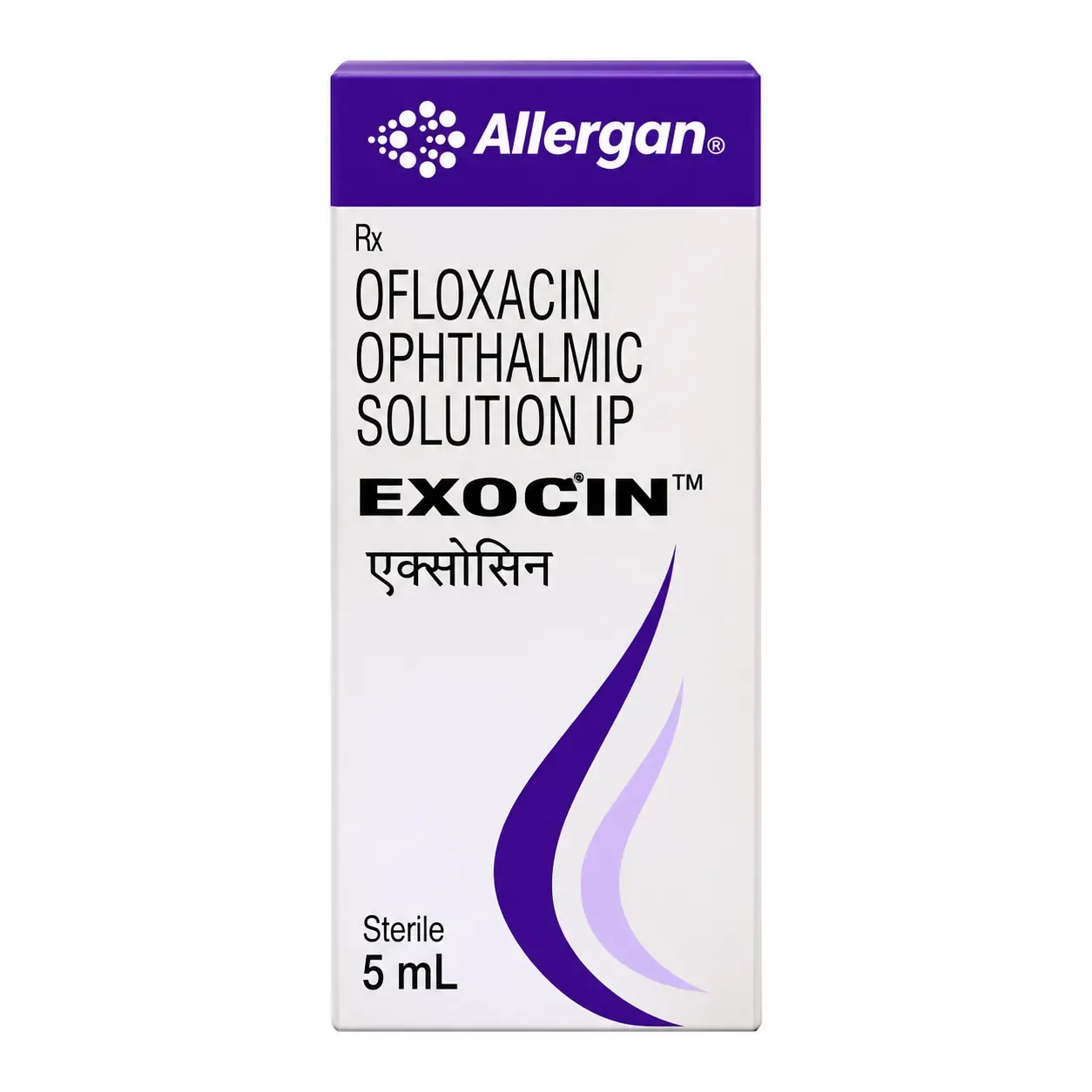
Product Name: Exocin Eye Drops 5 ml.
Strength: 0.3% w/v (3 mg/ml).
Dosage Form: Ophthalmic Solution.
Drug Class: Fluoroquinolone Antibiotic.
Therapeutic Category: Eye Care / Ophthalmic Antibiotics.
var kirkiViewports = {"md":{"value":1200,"scale":1,"minWidth":1200,"maxWidth":1200,"title":"Desktop","icon":"desktop","activeIcon":"desktop-hover","id":"md","type":"max"},"tablet":{"value":1199,"scale":1,"minWidth":1199,"maxWidth":1199,"title":"Tablet","icon":"tablet-default","activeIcon":"tablet-hover","type":"max","id":"tablet"},"mobile":{"value":767,"scale":1,"minWidth":767,"maxWidth":767,"title":"Phone","icon":"phone-vr-default","activeIcon":"phone-vr-hover","type":"max","id":"mobile"}};
var kirkiCSSVariable = {"data":[{"title":"Colors","key":"color","modes":[{"title":"Default","key":"default"}],"variables":[]},{"title":"Numbers","key":"size","modes":[{"title":"Default","key":"default"}],"variables":[]},{"title":"Text Styles","key":"text-style","modes":[{"title":"Default","key":"default"}],"variables":[]},{"title":"Font Family","key":"font-family","modes":[{"title":"Default","key":"default"}],"variables":[]}]};
var elementorFrontendConfig = {"environmentMode":{"edit":false,"wpPreview":false,"isScriptDebug":false},"i18n":{"shareOnFacebook":"Share on Facebook","shareOnX":"Share on X","pinIt":"Pin it","download":"Download","downloadImage":"Download image","fullscreen":"Fullscreen","zoom":"Zoom","share":"Share","playVideo":"Play Video","previous":"Previous","next":"Next","close":"Close","a11yCarouselPrevSlideMessage":"Previous slide","a11yCarouselNextSlideMessage":"Next slide","a11yCarouselFirstSlideMessage":"This is the first slide","a11yCarouselLastSlideMessage":"This is the last slide","a11yCarouselPaginationBulletMessage":"Go to slide"},"is_rtl":false,"breakpoints":{"xs":0,"sm":480,"md":768,"lg":1025,"xl":1440,"xxl":1600},"responsive":{"breakpoints":{"mobile":{"label":"Mobile Portrait","value":767,"default_value":767,"direction":"max","is_enabled":true},"mobile_extra":{"label":"Mobile Landscape","value":880,"default_value":880,"direction":"max","is_enabled":false},"tablet":{"label":"Tablet Portrait","value":1024,"default_value":1024,"direction":"max","is_enabled":true},"tablet_extra":{"label":"Tablet Landscape","value":1200,"default_value":1200,"direction":"max","is_enabled":false},"laptop":{"label":"Laptop","value":1366,"default_value":1366,"direction":"max","is_enabled":false},"widescreen":{"label":"Widescreen","value":2400,"default_value":2400,"direction":"min","is_enabled":false}},"hasCustomBreakpoints":false},"version":"4.4.0","is_static":false,"experimentalFeatures":{"e_font_icon_svg":true,"additional_custom_breakpoints":true,"container":true,"theme_builder_v2":true,"e_mcp_revision_snapshots":true,"nested-elements":true,"import-export-customization":true,"e_pro_atomic_form":true,"e_pro_collection_loop":true,"mega-menu":true,"e_pro_variables":true,"e_pro_interactions":true},"urls":{"assets":"https:\/\/easyrxdrug.com\/wp-content\/plugins\/elementor\/assets\/","ajaxurl":"https:\/\/easyrxdrug.com\/wp-admin\/admin-ajax.php","uploadUrl":"https:\/\/easyrxdrug.com\/wp-content\/uploads"},"nonces":{"floatingButtonsClickTracking":"ec621973a0","atomicFormsSendForm":"008008087d"},"swiperClass":"swiper","settings":{"page":[],"editorPreferences":[]},"kit":{"active_breakpoints":["viewport_mobile","viewport_tablet"],"global_image_lightbox":"yes","lightbox_enable_counter":"yes","lightbox_enable_fullscreen":"yes","lightbox_enable_zoom":"yes","lightbox_enable_share":"yes","lightbox_title_src":"title","lightbox_description_src":"description","woocommerce_notices_elements":[]},"post":{"id":20837,"title":"Exocin%20Eye%20Drops%205%20ml%20-%20EasyRxDrug","excerpt":"","featuredImage":"https:\/\/easyrxdrug.com\/wp-content\/uploads\/2026\/11\/Allergan-Exocin-Eye-Drops-Packaging-1024x1024.webp"}};
//# sourceURL=elementor-frontend-js-before
var erxCart = {"refreshUrl":"/?wc-ajax=get_refreshed_fragments","qtyUrl":"/?wc-ajax=erx_cart_qty","i18n":{"item":"item","items":"items","error":"Could not update your cart. Please try again."}};
//# sourceURL=erx-cart-js-extra
var erxPP = {"ajaxUrl":"/?wc-ajax=add_to_cart","cartUrl":"https://easyrxdrug.com/cart/","checkoutUrl":"https://easyrxdrug.com/checkout/","currency":{"symbol":"$","decimals":2,"pos":"left"},"i18n":{"add":"Add to cart","added":"\u2713 Added to cart","error":"Could not add to cart. Please try again.","close":"Close","choose":"Choose pack size"}};
//# sourceURL=erx-product-js-extra
var gglcptch = {"options":{"version":"v2","sitekey":"6LdChI0oAAAAAE5UwhXqAHlTe_8Mi-6wUovqU909","error":"\u003Cstrong\u003EWarning\u003C/strong\u003E: More than one reCAPTCHA has been found in the current form. Please remove all unnecessary reCAPTCHA fields to make it work properly.","disable":0,"theme":"light"},"vars":{"visibility":false}};
//# sourceURL=gglcptch_script-js-extra
var wpforms_settings = {"val_required":"This field is required.","val_email":"Please enter a valid email address.","val_email_suggestion":"Did you mean {suggestion}?","val_email_suggestion_title":"Click to accept this suggestion.","val_email_restricted":"This email address is not allowed.","val_number":"Please enter a valid number.","val_number_positive":"Please enter a valid positive number.","val_minimum_price":"Amount entered is less than the required minimum.","val_confirm":"Field values do not match.","val_checklimit":"You have exceeded the number of allowed selections: {#}.","val_limit_characters":"{count} of {limit} max characters.","val_limit_words":"{count} of {limit} max words.","val_limit_min_characters":"Minimum is {min} characters. Characters needed: {needed}.","val_limit_min_words":"Minimum is {min} words. Words needed: {needed}.","val_limit_between_characters_needed":"Between {min} and {max} characters. Characters needed: {needed}","val_limit_between_characters_remaining":"Between {min} and {max} characters. Characters remaining: {remaining}","val_limit_between_words_needed":"Between {min} and {max} words. Words needed: {needed}","val_limit_between_words_remaining":"Between {min} and {max} words. Words remaining: {remaining}","val_min":"Please enter a value greater than or equal to {0}.","val_max":"Please enter a value less than or equal to {0}.","val_recaptcha_fail_msg":"Google reCAPTCHA verification failed, please try again later.","val_turnstile_fail_msg":"Cloudflare Turnstile verification failed, please try again later.","val_inputmask_incomplete":"Please fill out the field in required format.","uuid_cookie":"","locale":"en","country":"","country_list_label":"Country list","wpforms_plugin_url":"https:\/\/easyrxdrug.com\/wp-content\/plugins\/wpforms-lite\/","gdpr":"","ajaxurl":"https:\/\/easyrxdrug.com\/wp-admin\/admin-ajax.php","mailcheck_enabled":"1","mailcheck_domains":[],"mailcheck_toplevel_domains":["dev"],"is_ssl":"1","nonce":"a4074b18be","currency_code":"USD","currency_thousands":",","currency_decimals":"2","currency_decimal":".","currency_symbol":"$","currency_symbol_pos":"left","val_requiredpayment":"Payment is required.","val_creditcard":"Please enter a valid credit card number.","css_vars":["field-border-radius","field-border-style","field-border-size","field-background-color","field-border-color","field-text-color","field-menu-color","label-color","label-sublabel-color","label-error-color","button-border-radius","button-border-style","button-border-size","button-background-color","button-border-color","button-text-color","page-break-color","background-image","background-position","background-repeat","background-size","background-width","background-height","background-color","background-url","container-padding","container-border-style","container-border-width","container-border-color","container-border-radius","field-size-input-height","field-size-input-spacing","field-size-font-size","field-size-line-height","field-size-padding-h","field-size-checkbox-size","field-size-sublabel-spacing","field-size-icon-size","label-size-font-size","label-size-line-height","label-size-sublabel-font-size","label-size-sublabel-line-height","button-size-font-size","button-size-height","button-size-padding-h","button-size-margin-top","container-shadow-size-box-shadow"],"isModernMarkupEnabled":"1","formErrorMessagePrefix":"Form error message","submitBtnDisabled":"Submit button is disabled during form submission.","readOnlyDisallowedFields":["captcha","map","content","divider","hidden","html","entry-preview","pagebreak","payment-total"],"error_updating_token":"Error updating token. Please try again or contact support if the issue persists.","network_error":"Network error or server is unreachable. Check your connection or try again later.","token_cache_lifetime":"86400","hn_data":{"20165":8},"analytics_composite_field_types":["name","address","date-time","email","password","paypal-commerce"],"analytics_base64":"1","address_field":{"list_countries_without_states":["GB","DE","CH","NL"]}}


 $9.00 – $29.00Price range: $9.00 through $29.00 Choose Pack This product has multiple variants. The options may be chosen on the product page


Reviews
There are no reviews yet.