
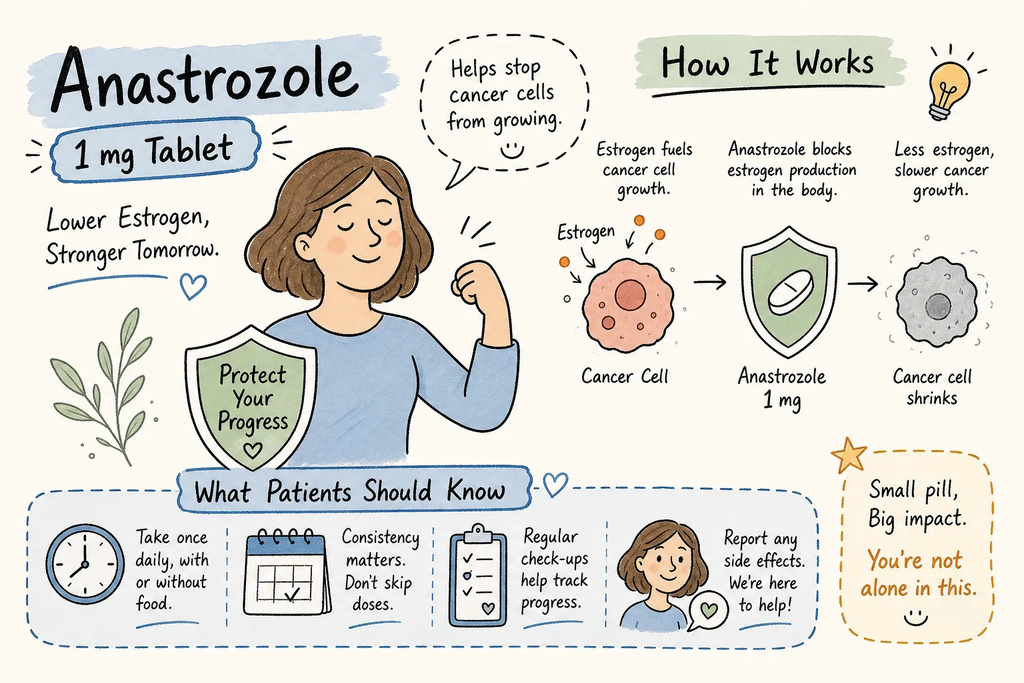
Anastrozole 1 mg oral tablet is one of the most widely prescribed aromatase inhibitors for postmenopausal women managing hormone receptor-positive breast cancer. Despite that, a significant number of patients start the medication without a clear picture of what it’s actually doing in the body, what side effects deserve attention, or what their options look like when the pharmacy bill arrives. That information gap matters, patients who understand their treatment are more likely to stick with it.
Some patients are now using online pharmacies to fill prescriptions at more manageable prices. That can be a reasonable decision, provided they’re buying from a legitimate, licensed source and not compromising on drug quality. Before going that route, it’s worth knowing how to verify an online pharmacy: confirm a valid state board of pharmacy license, look for a U.S. physical address and a licensed pharmacist on staff, ensure a valid prescription is required, and check for NABP listing or VIPPS accreditation.
This article covers how anastrozole works, how to take it correctly, which side effects deserve attention, which drug interactions to flag with your doctor, and how to stop overpaying for a medication that has been available as a generic for years.
What anastrozole actually is and how it works
Anastrozole belongs to a class of drugs called aromatase inhibitors. Your body uses an enzyme called aromatase to convert androgens into estrogen. Anastrozole blocks that enzyme, which causes estrogen levels to drop sharply. In hormone receptor-positive breast cancer, estrogen acts as fuel for tumor growth. Block the enzyme, cut the fuel supply, and you slow or stop that growth. This is a targeted hormonal approach, not chemotherapy.
The FDA has approved anastrozole for three specific uses in postmenopausal women:
- Adjuvant treatment of early-stage hormone receptor-positive breast cancer after primary treatment such as surgery
- First-line treatment of locally advanced or metastatic hormone receptor-positive breast cancer
- Treatment of advanced breast cancer that has progressed after tamoxifen therapy
The “postmenopausal” qualifier is not a footnote. Anastrozole does not work effectively as monotherapy in premenopausal women unless ovarian function has been medically suppressed. That distinction matters more than most patient information leaflets acknowledge, and it’s worth confirming with your oncology team if there’s any ambiguity about your hormonal status.
How to take the anastrozole 1 mg oral tablet correctly
The dosing is straightforward: one 1 mg tablet, taken orally, once daily. It can be taken with or without food. No complicated titration schedule, no dose adjustment required for most patients with renal impairment or older age. What matters most is consistency. Taking it at the same time each day maintains stable blood levels, a principle supported broadly by oncology adherence literature, and builds the treatment discipline that actually affects outcomes.
Duration is where the picture gets more nuanced. For adjuvant early breast cancer, ASCO and NCCN guidelines both support 5 years of anastrozole as the standard course, based primarily on the ATAC trial. For higher-risk patients, particularly those with node-positive disease, total adjuvant endocrine therapy may extend toward 7 to 10 years, either by continuing anastrozole or by transitioning between agents. The ABCSG-16 trial provided a useful data point: 2 additional years of anastrozole after an initial 5-year course delivered similar benefit to 5 additional years, with fewer fractures. So extending to a full 10 years is not automatically the right call, even in higher-risk patients.
For advanced or metastatic disease, treatment continues until there is documented tumor progression, meaning imaging or clinical evidence that the cancer is growing despite therapy. Duration should always be resolved in collaboration with your oncology team, factoring in nodal status, tumor grade, bone health, and how well you’re tolerating the medication.
Side effects: what’s common, what’s serious, and when to call your doctor
Common side effects
Grounding side effect expectations in real data helps patients stay on treatment rather than quitting when something unexpected happens. From the ATAC trial, hot flashes affect roughly 25 to 34% of patients. Joint pain, arthralgia, and stiffness are among the most frequently reported complaints and are a meaningful driver of early discontinuation. Bone loss is a real longer-term risk because estrogen suppression directly reduces bone mineral density. Fatigue, nausea, headache, insomnia, depression, and peripheral edema are also commonly reported. These effects are manageable for many women, but they are not trivial, and knowing they’re coming makes it easier to stay the course.
Serious side effects
On the more serious end: in women with pre-existing ischemic heart disease, cardiovascular events occur more frequently with anastrozole than with tamoxifen. That’s a real risk-benefit conversation worth having before you start, not after. Venous thromboembolic events were reported at roughly 4% in ATAC analyses. Severe allergic reactions, including facial or throat swelling, are rare but require immediate attention. Liver injury can occur as well, jaundice, right-upper-abdominal pain, and marked fatigue are red flags that warrant prompt evaluation, not a wait-and-see approach.
When to call your doctor immediately
Contact your care team right away if you experience chest pain, sudden neurologic symptoms, difficulty breathing, or skin that is blistering or peeling. These are not tolerable side effects to manage at home, and prompt reporting can prevent serious harm.
Drug interactions, contraindications, and what your doctor should monitor
The most clinically significant interactions with anastrozole are pharmacodynamic, meaning they work against the drug’s mechanism rather than affecting how it’s metabolized. Tamoxifen reduces anastrozole exposure and provides no additional benefit when used concurrently, do not take them together. Systemic estrogen products, including hormone replacement therapy and estrogen-containing contraceptives, directly oppose anastrozole’s estrogen-suppressing mechanism and must be avoided. Raloxifene should generally not be combined with anastrozole unless an oncology specialist has specifically directed it.
Anastrozole is contraindicated in pregnancy and is not appropriate during breastfeeding. Pre-existing ischemic heart disease and high fracture risk both require careful risk-benefit assessment. For monitoring, the key areas are bone mineral density (baseline DXA scan, then typically every 1 to 2 years), lipid levels, blood pressure and cardiovascular symptoms, and liver function if there is underlying liver disease or new symptoms. Arthralgia and mood changes should be reviewed at follow-up visits, not just noted in the intake paperwork and forgotten.
Before starting anastrozole, your prescriber should reconcile all your current medications, including supplements and over-the-counter products, particularly anticoagulants, osteoporosis drugs, or anything estrogen-related. This isn’t optional housekeeping. It directly affects whether the drug does what it’s supposed to do.
Generic anastrozole 1 mg oral tablet vs. Arimidex: what you’re actually paying for
Arimidex, the original brand from AstraZeneca, can carry a retail price of $200 to $600 or more for a 30 to 90-tablet supply. Generic anastrozole 1 mg tablets are bioequivalent to Arimidex, same active ingredient, same 1 mg strength, same FDA standard. The difference between the two is the appearance of the tablet, the inactive excipients, and the packaging. The therapeutic effect is identical.
FDA-approved generic manufacturers include Teva, Aurobindo, Accord, Zydus, Natco, and others. Cash prices for generic anastrozole at standard pharmacies typically run $10 to $30 for a 30-day supply, and some 90-tablet quotes come in around $30 total. Generic anastrozole is commonly covered by Medicare Part D, Medicare Advantage, and most commercial plans as a preferred or low-tier generic. For patients without coverage or with high-deductible plans, a 90-day supply from some online or mail-order pharmacies can be less expensive than standard retail, though prices vary by vendor. When filling a prescription, ask specifically for “generic anastrozole 1 mg” every time, don’t assume the pharmacy will default to it.
One practical note: pharmacies may dispense from different FDA-approved manufacturers from month to month. The active ingredient and strength remain the same, but the tablet’s appearance may change. That’s normal and not a safety concern.
Where to buy anastrozole online without overpaying
In the United States, anastrozole requires a valid prescription from a licensed provider. Any online pharmacy selling it without one is a red flag, not a bargain. A legitimate online pharmacy requires a prescription, provides a verifiable physical address and phone number, and employs a licensed pharmacist. The pharmacy should also be authorized to ship prescription medications into your state. These aren’t bureaucratic technicalities, they’re the minimum baseline for knowing what you’re actually receiving.
Easyrxdrug Online Pharmacy carries generic anastrozole at competitive prices. Before placing any order, with Easyrxdrug or any other online pharmacy, confirm that the pharmacy holds a current state board of pharmacy license, employs a licensed pharmacist, requires a valid prescription, and has a verifiable U.S. address. Patients with long-term treatment courses may find that ordering a 90-day supply from a licensed online pharmacy reduces out-of-pocket costs compared to month-by-month retail fills; compare options and verify credentials before purchasing.
The bottom line on anastrozole 1 mg oral tablet treatment
Anastrozole 1 mg oral tablet is a well-established, effective aromatase inhibitor. For most postmenopausal women with hormone receptor-positive breast cancer, the generic version delivers the same therapeutic result as Arimidex at a fraction of the cost. The brand name on the bottle does not change how the molecule works in your body.
Understand the dosing, know which side effects warrant a call to your doctor, flag the drug interactions with your oncology team, and stay on top of bone health and cardiovascular monitoring. Those are the factors that actually determine how well treatment goes. Before starting, have an honest conversation with your clinician about treatment duration, your specific risk factors, and which symptoms to report. Patients who go in with realistic expectations and a clear plan consistently fare better on long-term endocrine therapy.
If cost is a barrier to staying on your anastrozole 1 mg oral tablet regimen, that’s a solvable problem. A licensed online pharmacy like Easyrxdrug can be one option for making long-term treatment more financially manageable, provided you’ve confirmed its credentials. Affordable, consistent treatment is too important to leave to chance.
Where to Buy: Click Here