
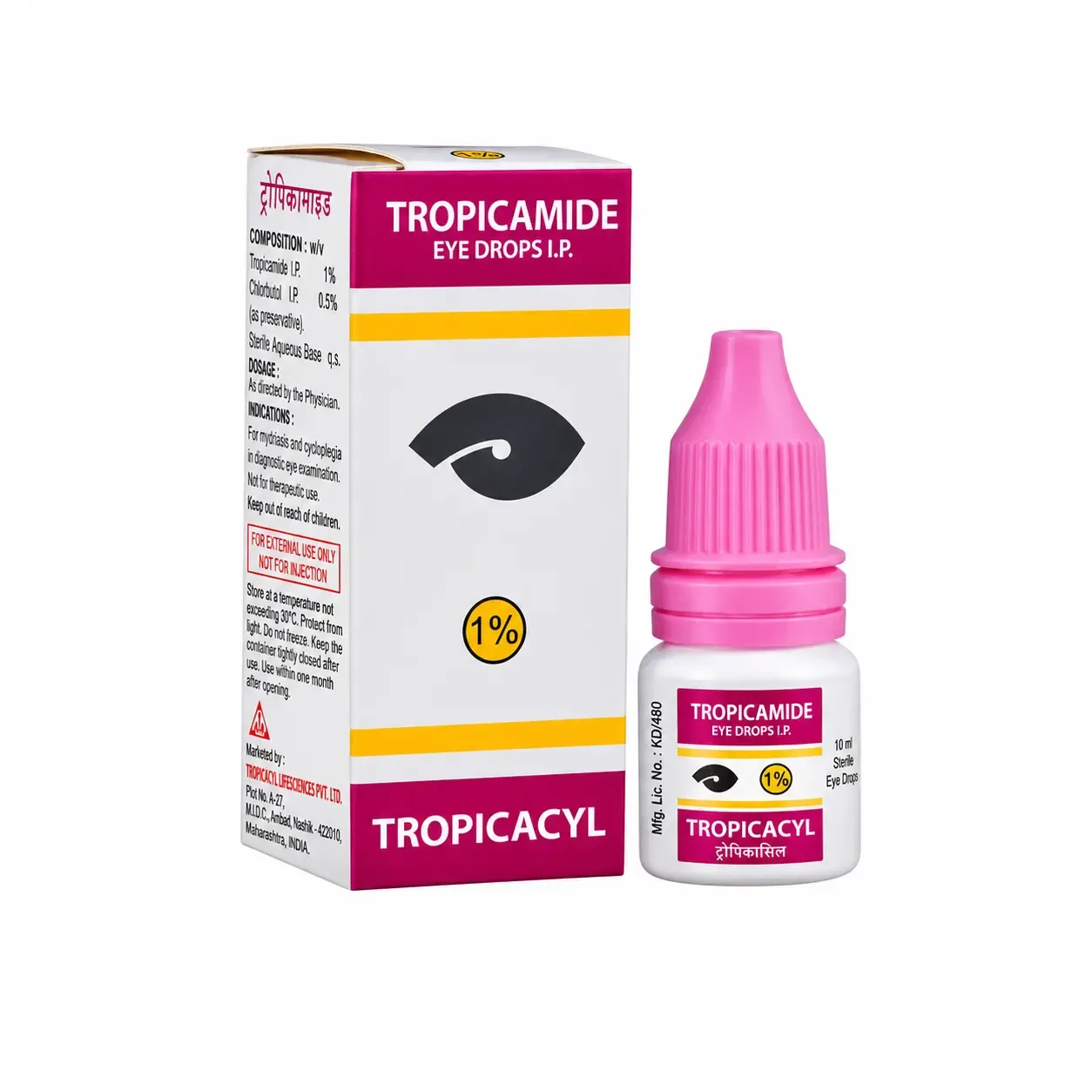
Tropicacyl (Tropicamide)
Want to order in bulk / B2B price?
Every order ships with a tracking number. Standard delivery takes 12–15 days.
If your parcel doesn't arrive, choose a new package or a full refund.
Call +1 251-332-4105 or email [email protected].
Share
What Is Tropicacyl (Tropicamide) Eye Drops?
Tropicacyl Eye Drops is a prescription ophthalmic medication containing Tropicamide 1% w/v, an antimuscarinic pharmaceutical ingredient used primarily for diagnostic eye examinations.
Tropicamide temporarily enlarges the pupil, a process known as mydriasis, and reduces the eye’s ability to focus on nearby objects through cycloplegia.
These effects allow ophthalmologists to examine internal eye structures, including the retina, optic nerve, macula, and ocular blood vessels.
Tropicamide is also used during selected refractive examinations and ophthalmic procedures where temporary pupil dilation is required.
Unlike medications used to manage glaucoma, Tropicacyl does not reduce elevated intraocular pressure. It is primarily a diagnostic ophthalmic preparation rather than a routine daily eye care medication.
How Does Tropicacyl Eye Drops Work?
1. Ophthalmic Administration
Tropicamide is administered directly into the eye, where it acts on the iris and ciliary muscles.
2. Muscarinic Receptor Blockade
Tropicamide temporarily blocks muscarinic acetylcholine receptors within ocular tissues.
3. Iris Sphincter Muscle Relaxation
Blocking parasympathetic stimulation reduces contraction of the iris sphincter muscle.
4. Pupil Dilation
Reduced iris sphincter activity allows the pupil to enlarge, providing improved visibility of internal eye structures.
5. Temporary Cycloplegia
Tropicamide reduces ciliary muscle activity, temporarily interfering with the eye’s ability to focus on nearby objects.
6. Improved Diagnostic Examination
Pupil dilation enables ophthalmologists to examine the retina, optic disc, macula, and other internal structures more effectively.
7. Temporary Pharmaceutical Action
The effects of tropicamide gradually diminish as the medication’s pharmacological activity decreases.
Uses of Tropicacyl Eye Drops
1. Pupil Dilation (Mydriasis)
Tropicacyl is primarily used to temporarily enlarge the pupil during ophthalmic examinations and diagnostic procedures.
2. Fundus Examination
Pupil dilation allows ophthalmologists to examine the retina, optic nerve, retinal blood vessels, and macula.
3. Cycloplegic Refraction
Tropicamide temporarily reduces the eye’s focusing ability, assisting with selected refractive assessments.
A longer-acting cycloplegic medication may be preferred when stronger cycloplegia is required, particularly in children.
4. Diabetic Retinopathy Screening
Dilated eye examinations help healthcare professionals identify retinal abnormalities associated with diabetes.
Tropicamide assists with examination but does not directly treat diabetic retinopathy.
5. Retinal Disease Examination
Tropicacyl may support the evaluation of retinal disorders, including macular degeneration, retinal tears, and other retinal abnormalities.
6. Optic Nerve Assessment
Pupil dilation helps ophthalmologists assess optic nerve appearance during comprehensive eye examinations.
7. Ophthalmic Surgical Procedures
Tropicamide may be administered as part of selected ophthalmic procedures requiring pupil dilation.
8. Selected Cases of Anterior Uveitis
Ophthalmologists may prescribe mydriatic or cycloplegic medications as supportive treatment for certain cases of anterior uveitis.
Tropicamide does not directly treat the underlying inflammation. Other longer-acting medications may be preferred depending on the condition.
Important: Tropicacyl is not intended to treat bacterial eye infections, dry eyes, allergic conjunctivitis, cataracts, or elevated intraocular pressure.
Benefits of Tropicacyl Eye Drops
1. Effective Temporary Pupil Dilation
Tropicamide produces temporary mydriasis, supporting comprehensive ophthalmic examinations.
2. Improved Retinal Visualization
Pupil enlargement allows healthcare professionals to examine internal retinal structures more clearly.
3. Relatively Rapid Pharmacological Action
Tropicamide generally begins producing its intended effects within approximately 15–30 minutes.
4. Short-Acting Mydriatic Formulation
Compared with longer-acting medications such as atropine, tropicamide generally has a shorter duration of action.
5. Supports Diagnostic Accuracy
Improved visualization and temporary reduction in accommodation may assist with selected ophthalmic diagnostic assessments.
6. Supports Comprehensive Eye Health Evaluation
Tropicamide facilitates examinations used to identify retinal, optic nerve, and other ocular abnormalities.
7. Temporary Cycloplegic Activity
The medication temporarily reduces accommodation, which may assist with selected refractive examinations.
8. Established Ophthalmic Ingredient
Tropicamide has an established history of clinical use in diagnostic ophthalmology.
Tropicacyl Eye Drops Dosage and Administration
The appropriate dosage depends on the patient’s age, medical history, ophthalmic condition, and the type of diagnostic procedure being performed.
Tropicacyl should generally be administered by an ophthalmologist or trained healthcare professional.
Reference Dosage for Mydriasis
For diagnostic pupil dilation, authorized tropicamide formulations may be administered as one or two drops in the eye approximately 15–20 minutes before examination, depending on the concentration and clinical protocol.
Reference Dosage for Cycloplegic Refraction
For cycloplegic refraction, licensed tropicamide 1% formulations may be administered as one or two drops, with repeat administration after approximately five minutes when clinically necessary.
These are general professional reference regimens and are not instructions for unsupervised self-medication.
How to Use Tropicacyl Eye Drops
- Wash your hands thoroughly before administration.
- Remove contact lenses, if applicable.
- Tilt your head backward and gently pull down the lower eyelid.
- Hold the dropper above the eye without touching the eye or surrounding skin.
- Instill the prescribed number of drops into the lower conjunctival sac.
- Gently close the eye without excessive blinking.
- Apply gentle pressure near the inner corner of the eye for two to three minutes to help reduce systemic absorption.
- Wipe away excess solution from the surrounding skin.
- Replace the bottle cap immediately after administration.
- Wash your hands after handling the medication, particularly when administering it to children.
Avoid touching the dropper tip to any surface because contamination may increase the risk of eye infections.
Can Tropicacyl Be Used With Contact Lenses?
Contact lenses should generally be removed before administration. Follow the ophthalmologist’s instructions regarding when they may be safely reinserted.
Can Tropicacyl Be Used With Other Eye Drops?
Tropicacyl may be used alongside other ophthalmic medications when clinically appropriate.
Allow at least five minutes between different ophthalmic preparations unless the healthcare professional provides a different clinical protocol.
What If a Dose Is Missed?
Tropicacyl is commonly administered for diagnostic procedures rather than according to a routine daily schedule.
If prescribed for another ophthalmic condition, follow the ophthalmologist’s instructions regarding missed doses. Do not administer additional doses independently.
What Happens in Case of Overdose?
Excessive tropicamide exposure may cause severe systemic anticholinergic reactions, including rapid heartbeat, confusion, dry mouth, fever, agitation, and difficulty urinating.
Contact a healthcare professional or poison control service promptly if accidental ingestion or excessive exposure occurs.
Children and infants may be particularly susceptible to serious systemic effects.
How Long Does Tropicacyl Take to Work?
Tropicamide generally begins producing pupil dilation within approximately 15–30 minutes following ophthalmic administration.
Its effects typically last approximately three to eight hours, although complete recovery may require up to 24 hours in some individuals.
The duration depends on medication concentration, dosage, iris pigmentation, age, and individual response.
Temporary blurred near vision and increased sensitivity to light may continue until the medication’s effects have diminished.
Common Side Effects
Possible side effects associated with Tropicacyl Eye Drops include:
- Temporary blurred vision
- Increased sensitivity to light
- Eye irritation
- Burning sensation
- Stinging sensation
- Eye redness
- Temporary difficulty focusing
- Eye discomfort
- Dry mouth
- Headache
- Increased heart rate
Most mild local adverse effects are temporary. Persistent, severe, or unusual symptoms should be reported to a healthcare professional.
Potentially Harmful Effects & Serious Health Risks
1. Acute Angle-Closure Glaucoma
Tropicamide-induced pupil dilation may trigger acute angle-closure glaucoma in individuals with anatomically narrow anterior chamber angles.
Symptoms may include severe eye pain, headache, blurred vision, halos around lights, nausea, and vomiting.
This condition requires emergency medical attention.
2. Increased Intraocular Pressure
Tropicamide may temporarily increase intraocular pressure in susceptible individuals.
Patients with glaucoma or a history of elevated eye pressure require appropriate ophthalmological assessment.
3. Severe Anticholinergic Reactions
Systemic absorption may cause dry mouth, rapid heartbeat, reduced sweating, urinary retention, and elevated body temperature.
4. Central Nervous System Effects
Rare systemic reactions may include confusion, agitation, hallucinations, unusual behavior, or seizures.
Children may be particularly vulnerable to these reactions.
5. Cardiovascular Complications
Systemic anticholinergic activity may cause an increased heart rate and, rarely, other cardiovascular complications.
6. Severe Allergic Reactions
Allergic reactions may include significant eye swelling, facial swelling, skin rash, and breathing difficulties.
7. Temporary Visual Impairment
Pupil dilation and cycloplegia may temporarily interfere with activities requiring clear vision, including driving and reading.
8. Eye Infection Due to Contamination
Contaminated dropper tips may introduce microorganisms into the ophthalmic solution and increase the risk of eye infections.
Emergency Warning: Seek immediate medical attention for severe eye pain, sudden vision loss, halos around lights accompanied by nausea, significant confusion, seizures, breathing difficulties, or severe allergic reactions.
Contraindications & Safety Precautions
1. Tropicamide Allergy
Tropicacyl should not be used by individuals with known hypersensitivity to tropicamide or other formulation ingredients.
2. Narrow-Angle Glaucoma
Patients with untreated narrow-angle glaucoma or anatomically narrow anterior chamber angles require specialist assessment before pupil dilation.
3. Elevated Intraocular Pressure
Patients with glaucoma or ocular hypertension should inform their ophthalmologist before administration.
4. Pediatric Use
Infants and children may be more sensitive to systemic anticholinergic effects. Pediatric administration requires careful dosage selection and medical supervision.
5. Older Adults
Older individuals may be more susceptible to certain systemic anticholinergic reactions, particularly confusion and cardiovascular effects.
6. Cardiovascular Conditions
Patients with significant heart disease or heart rhythm disorders should inform their healthcare professional before administration.
7. Pregnancy
Pregnant women or women planning pregnancy should consult their healthcare professional before receiving tropicamide.
8. Breastfeeding
Breastfeeding women should discuss the potential risks and benefits of tropicamide administration with their healthcare professional.
9. Driving and Operating Machinery
Avoid driving, operating machinery, or performing activities requiring clear vision until normal visual function returns.
10. Sunlight Exposure
Pupil dilation may increase sensitivity to bright light. Sunglasses may help reduce discomfort until the effects diminish.
11. Contact Lens Use
Remove contact lenses before administration and follow the ophthalmologist’s instructions regarding reinsertion.
12. Accidental Ingestion
Tropicacyl is intended for ophthalmic administration only. Accidental ingestion may result in serious systemic reactions, particularly in children.
Drug Interactions
Other Anticholinergic Medicines
Concurrent use with atropine, scopolamine, or other anticholinergic medications may increase the risk of systemic adverse effects.
Antihistamines
Certain first-generation antihistamines, including diphenhydramine and chlorpheniramine, possess anticholinergic activity and may contribute to additive adverse effects.
Tricyclic Antidepressants
Amitriptyline and other tricyclic antidepressants may increase the overall anticholinergic burden.
Antipsychotic Medicines
Certain antipsychotic medications with anticholinergic properties may increase the risk of systemic reactions.
Pilocarpine Eye Drops
Pilocarpine promotes pupil constriction and may oppose the mydriatic action of tropicamide.
Ophthalmic Cholinesterase Inhibitors
Certain ophthalmic cholinesterase inhibitors may interact with the antimuscarinic activity of tropicamide.
Other Mydriatic Eye Drops
Phenylephrine may be administered alongside tropicamide during selected diagnostic procedures. Combination administration requires appropriate medical supervision.
Inform your ophthalmologist about all prescription medicines, over-the-counter medications, and ophthalmic treatments before using Tropicacyl.
Advantages / Pharmaceutical Characteristics
- Tropicamide 1% ophthalmic formulation
- Temporary pupil dilation
- Mydriatic pharmaceutical activity
- Cycloplegic pharmaceutical activity
- Relatively rapid onset of action
- Short-acting antimuscarinic formulation
- Retinal examination support
- Fundus examination support
- Refractive assessment support
- Ophthalmic diagnostic preparation
- Established active pharmaceutical ingredient
Disadvantages / Limitations
- Prescription required
- Requires ophthalmological supervision
- Temporary blurred vision
- Increased light sensitivity
- Eye irritation and stinging
- Temporary difficulty focusing
- Potential increase in intraocular pressure
- Risk of acute angle-closure glaucoma
- Possible systemic anticholinergic reactions
- Increased sensitivity in infants and children
- Not intended for routine daily eye care
- Does not directly treat retinal diseases
- Does not restore lost vision
Tropicacyl vs Atropine Eye Drops
Tropicamide and atropine belong to the antimuscarinic drug class and are used to produce mydriasis and cycloplegia.
Tropicamide generally provides relatively short-lasting pupil dilation, whereas atropine produces stronger and substantially longer-lasting cycloplegia.
Atropine’s effects may persist for several days or longer.
The appropriate medication depends on the patient’s age, ophthalmic condition, and diagnostic requirements.
Tropicacyl vs Cyclopentolate Eye Drops
Tropicamide and cyclopentolate are used for pupil dilation and cycloplegic examinations.
Cyclopentolate generally provides stronger cycloplegia than tropicamide and may be preferred for certain refractive examinations, particularly in children.
Tropicamide is frequently used for routine dilated fundus examinations because of its relatively short duration of action.
Tropicacyl vs Phenylephrine Eye Drops
Tropicamide produces pupil dilation by blocking muscarinic receptors within the iris.
Phenylephrine stimulates alpha-adrenergic receptors in the iris dilator muscle, producing pupil enlargement through a different mechanism.
Unlike tropicamide, phenylephrine does not produce significant cycloplegia.
Both medications may be used together during selected ophthalmic examinations under professional supervision.
Tropicacyl vs Travatan Eye Drops
Tropicacyl contains tropicamide and is primarily used for temporary pupil dilation during diagnostic eye examinations.
Travatan contains travoprost, a prostaglandin analogue used to reduce elevated intraocular pressure in patients with open-angle glaucoma and ocular hypertension.
These medications have different mechanisms of action, therapeutic purposes, and safety precautions. They are not interchangeable.
Storage Instructions
Store Tropicacyl Eye Drops according to the manufacturer’s labeled temperature and storage instructions.
Protect the ophthalmic solution from excessive heat, direct sunlight, and contamination.
Keep the bottle tightly closed when not in use. Avoid touching the dropper tip to the eye or any external surface.
Follow the manufacturer’s instructions regarding the permitted usage period after opening.
Do not use expired medication or solutions showing signs of discoloration, contamination, or deterioration.
Keep out of reach of children and pets.
Frequently Asked Questions
1. What is Tropicacyl Eye Drops used for?
Tropicacyl is primarily used to temporarily dilate the pupil during diagnostic ophthalmic examinations.
2. What is the active ingredient in Tropicacyl?
Tropicacyl contains Tropicamide 1% w/v, equivalent to 10 mg per milliliter.
3. Who manufactures Tropicacyl Eye Drops?
Tropicacyl is manufactured or marketed by Sunways (India) Pvt. Ltd.
4. How does Tropicacyl work?
Tropicamide blocks muscarinic receptors within the iris and ciliary muscles, producing temporary pupil dilation and cycloplegia.
5. How long does Tropicacyl take to work?
Tropicamide generally begins producing its effects within approximately 15–30 minutes.
6. How long does Tropicacyl last?
Its effects generally last three to eight hours, although complete recovery may take longer in some patients.
7. Can Tropicacyl cause blurred vision?
Yes. Temporary blurred vision, particularly when focusing on nearby objects, is an expected pharmacological effect.
| Product Details | Information |
|---|---|
| Product Name | Tropicacyl Eye Drops |
| Brand Name | Tropicacyl |
| Generic Name | Tropicamide |
| Active Ingredient | Tropicamide 1% w/v |
| Strength | 10 mg/ml |
| Pack Size | 3 ml / 5 ml – verify packaging |
| Dosage Form | Ophthalmic Solution |
| Manufacturer / Marketer | Sunways (India) Pvt. Ltd. |
| Drug Class | Anticholinergic / Antimuscarinic Agent |
| Therapeutic Category | Eye Care / Diagnostic Ophthalmic Medicine |
| Primary Uses | Mydriasis and Cycloplegia |
| Mechanism of Action | Blocks muscarinic receptors in the iris and ciliary muscles |
| Administration Route | Ophthalmic |
| Onset of Action | Approximately 15–30 minutes |
| Duration of Action | Approximately 3–8 hours; sometimes longer |
| Prescription Status | Prescription Required |
| Country of Origin | India |
| Dosage | As directed by an ophthalmologist |
| Common Side Effects | Temporary blurred vision, eye irritation, stinging, and light sensitivity |
| Major Safety Risks | Acute angle-closure glaucoma and systemic anticholinergic reactions |
| Storage | Follow manufacturer-specific storage instructions |
| Pack sizes | 1 eye drop, 3 eye drops, 6 eye drops |
Related products
-
 $35.00 – $101.00Price range: $35.00 through $101.00 Choose Pack This product has multiple variants. The options may be chosen on the product page
-
 $70.00 – $750.00Price range: $70.00 through $750.00 Choose Pack This product has multiple variants. The options may be chosen on the product page
-
 $69.00 – $200.00Price range: $69.00 through $200.00 Choose Pack This product has multiple variants. The options may be chosen on the product page
-
 $16.00 – $86.00Price range: $16.00 through $86.00 Choose Pack This product has multiple variants. The options may be chosen on the product page
Reviews
There are no reviews yet.